Why Inflammation and Your Hormones Are More Connected Than You Think
If you have ever wondered why your PMS feels worse during stressful seasons, why cramps seem to spike when you have been eating poorly, or why fatigue hits harder some months than others, inflammation is very likely part of the answer. Chronic low-grade inflammation is one of the most underappreciated drivers of hormonal disruption in women, and it does not operate in isolation. It weaves through every phase of your menstrual cycle, amplifying symptoms you already experience and quietly undermining systems you rely on every day.
The relationship runs in both directions. Your hormones influence your inflammatory response, and your inflammatory state shapes how well your hormones function. Understanding this loop is one of the most practical things you can do for your cycle health, your energy, and your long-term wellbeing.
What Is Inflammation, Really?
Inflammation is your immune system's first line of defence. When you have an injury or infection, acute inflammation kicks in, does its job, and resolves. That is healthy and necessary. The problem arises when inflammation becomes chronic: a low-level, persistent state of immune activation that does not switch off. This can be driven by factors like poor diet, high stress, disrupted sleep, environmental toxins, gut dysbiosis, and yes, hormonal imbalance itself.
Chronic inflammation does not always feel dramatic. It can show up as bloating, joint aches, brain fog, fatigue, heavier periods, worsening PMS, acne flares, and mood swings. Many women normalise these experiences without realising there is an underlying inflammatory driver making everything harder.
"Inflammation and the menstrual cycle are deeply intertwined. Prostaglandins, which are local inflammatory mediators, are essential for menstruation to occur, but when they are produced in excess, they drive the pain, cramping, and systemic symptoms that many women suffer through every month."
- Dr. Christiane Northrup, MD, Obstetrician-Gynaecologist and Author, Women's Bodies, Women's Wisdom
How Inflammation Shifts Across Your Cycle
Your menstrual cycle is not a static hormonal event. It is a dynamic, phase-dependent process, and your inflammatory status shifts with it. Knowing what is happening in each phase helps you work with your biology rather than against it.
Menstrual Phase: Inflammation Is at Its Peak
When your period begins, progesterone and oestrogen both drop sharply. This hormonal withdrawal triggers the release of prostaglandins, lipid compounds that cause the uterine lining to contract and shed. Prostaglandins are pro-inflammatory by nature, which is why menstruation involves a controlled inflammatory event.
In women with naturally balanced prostaglandin levels, this process is manageable. But in women with chronic underlying inflammation, prostaglandin production can be excessive, resulting in severe cramping, heavy bleeding, nausea, diarrhoea, and systemic fatigue. Research from the National Institute of Child Health and Human Development confirms that elevated prostaglandin levels are a primary driver of primary dysmenorrhoea (painful periods) in otherwise healthy women.
Follicular Phase: Your Natural Anti-Inflammatory Window
As oestrogen rises in the follicular phase, it brings with it a natural anti-inflammatory effect. Oestrogen, particularly oestradiol, has been shown to modulate immune function, reduce cytokine production, and lower markers of systemic inflammation. This is why many women feel genuinely good in the first half of their cycle: more energy, clearer skin, better mood, and fewer aches.
This phase is often a good time to take on harder workouts, social commitments, and cognitively demanding tasks, because your body is in a more resilient, lower-inflammation state.
Ovulation: A Brief Inflammatory Spike
Ovulation itself requires a localised inflammatory event. For the follicle to rupture and release an egg, immune cells must orchestrate a carefully timed pro-inflammatory response. This is normal and transient, but in women with high baseline inflammation, this phase can feel more pronounced, sometimes showing up as mid-cycle pelvic discomfort known as mittelschmerz, bloating, or a dip in energy.
Luteal Phase: Where Inflammation Amplifies PMS
After ovulation, progesterone rises. Progesterone has its own immune-modulating properties and is generally anti-inflammatory when levels are healthy. However, in the late luteal phase, as both oestrogen and progesterone begin to decline, inflammation can tick upward again. This is when PMS symptoms typically peak.
Elevated inflammatory cytokines like interleukin-6 (IL-6) and tumour necrosis factor-alpha (TNF-a) in the late luteal phase have been linked to worsening mood disturbances, pain sensitivity, and fluid retention. For women with PMDD (premenstrual dysphoric disorder), research suggests that an exaggerated inflammatory response to normal hormonal fluctuations may be a central mechanism.
"The immune system does not ignore the menstrual cycle. It is actively involved in every phase, from follicle development to implantation to menstruation. When a woman has chronic inflammation, every one of those phases becomes harder."
- Dr. Aviva Romm, MD, Integrative Physician, Yale School of Medicine-trained, Author of Hormone Intelligence
What Drives Chronic Inflammation in Women
Inflammation does not arise in a vacuum. Several common lifestyle and environmental factors contribute to chronically elevated inflammatory markers in women of reproductive age:
- Ultra-processed foods: High in refined seed oils, sugar, and additives that directly stimulate inflammatory pathways
- Blood sugar dysregulation: Insulin spikes drive the production of inflammatory cytokines and worsen hormonal balance
- Gut dysbiosis: An imbalanced gut microbiome increases intestinal permeability, allowing bacterial by-products to enter the bloodstream and trigger systemic inflammation
- Chronic psychological stress: Cortisol, when chronically elevated, paradoxically increases inflammatory signalling over time
- Insufficient sleep: Even short-term sleep deprivation raises IL-6 and CRP, two key markers of inflammation
- Environmental toxins: Plastics, pesticides, and endocrine-disrupting chemicals can trigger immune activation and worsen hormonal disruption
- Excess body fat: Adipose tissue, particularly visceral fat, is metabolically active and secretes pro-inflammatory adipokines
The Inflammation-Hormone Feedback Loop
Here is where it gets particularly important for women tracking their cycles. Chronic inflammation does not just make symptoms worse. It actively disrupts hormone production at the source.
Inflammatory cytokines can suppress the hypothalamic-pituitary-ovarian (HPO) axis, the signalling cascade that orchestrates your entire cycle. When inflammatory signals reach the hypothalamus, they can blunt the release of GnRH (gonadotropin-releasing hormone), which then reduces the pituitary's output of LH and FSH, which then impairs ovulation, lowers progesterone production, and can shorten or lengthen cycle length unpredictably.
A study published in the Journal of Neuroinflammation found that systemic inflammatory cytokines can cross into the central nervous system and directly impair neuroendocrine signalling, including the reproductive axis. This means that what is happening in your gut, your fat tissue, or your bloodstream can have a direct effect on whether you ovulate and how much progesterone your body produces in the second half of your cycle.
Inflammation also impairs oestrogen metabolism in the liver, disrupts the gut estrobolome (the community of gut bacteria responsible for clearing used oestrogen), and can drive oestrogen dominance by slowing clearance rather than increasing production.
Key Takeaway
Chronic inflammation disrupts the HPO axis, impairs progesterone production, slows oestrogen clearance, and amplifies every phase-specific symptom from cramps to PMS to mood shifts. Reducing inflammation is not a luxury. It is foundational cycle care.
How to Lower Inflammation Across Your Cycle
The good news is that inflammation is highly responsive to lifestyle inputs. You do not need pharmaceutical intervention to shift your inflammatory status meaningfully. These strategies work across the cycle and build over time.
Anti-Inflammatory Nutrition
Food is your most powerful lever. An anti-inflammatory diet is not a restrictive diet. It is a nutrient-dense, whole-food approach that prioritises specific compounds:
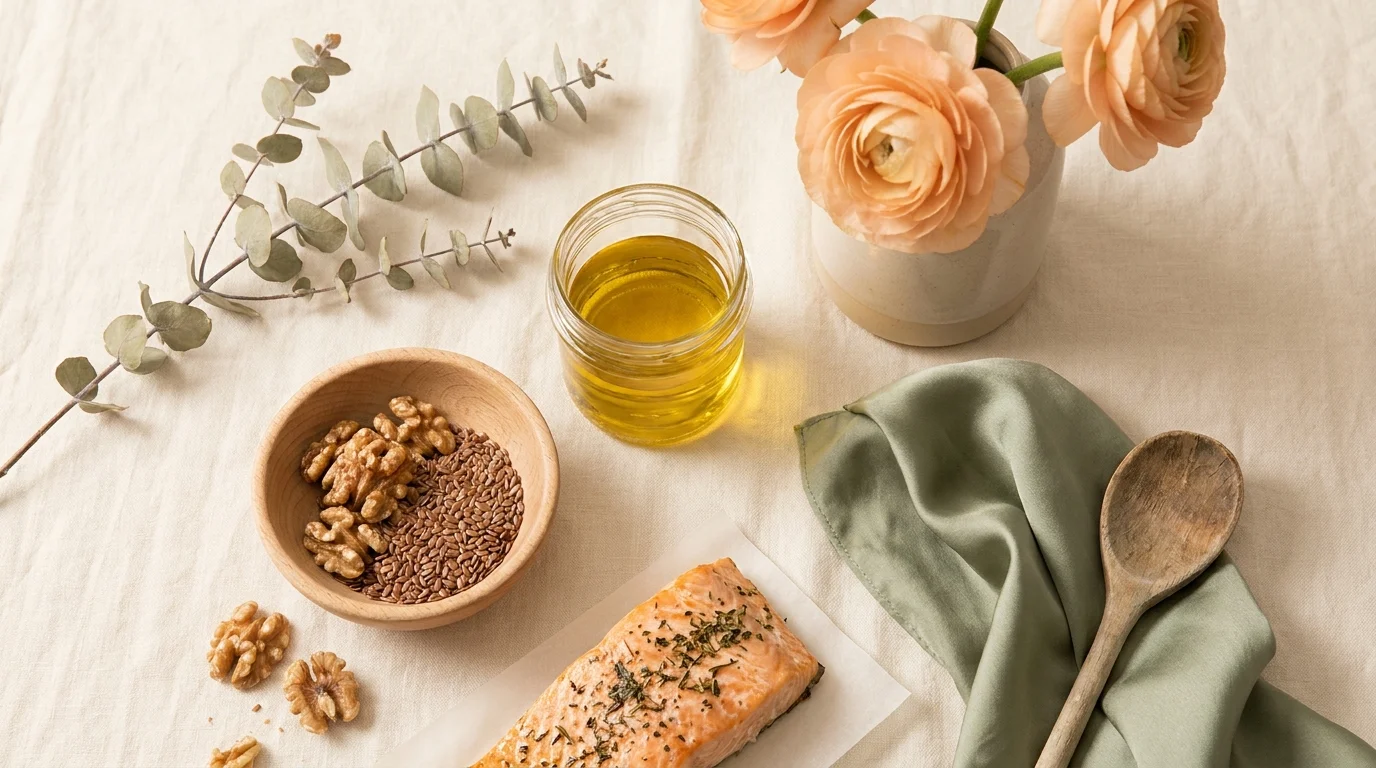
- Omega-3 fatty acids from oily fish, flaxseed, chia, and walnuts directly inhibit the production of pro-inflammatory prostaglandins
- Polyphenols from berries, dark leafy greens, olive oil, and green tea activate anti-inflammatory pathways including Nrf2
- Fibre-rich foods support the gut microbiome and reduce circulating inflammatory markers
- Magnesium-rich foods like pumpkin seeds, dark chocolate, and leafy greens are associated with lower CRP levels
- Turmeric contains curcumin, one of the most studied natural anti-inflammatory compounds, with evidence supporting its role in reducing prostaglandin-driven period pain
- Cruciferous vegetables like broccoli and Brussels sprouts support liver detoxification and oestrogen clearance
On the other side, reducing processed foods, refined sugar, refined vegetable oils, and alcohol will lower your baseline inflammatory load meaningfully within weeks.
Cycle-Phase Specific Strategies
Rather than applying a blanket approach, you can time your anti-inflammatory efforts to match where your body is in the cycle:
- Menstrual phase: Prioritise omega-3s, magnesium, and warming foods like ginger broth. Avoid alcohol and high-sugar foods that worsen prostaglandin production. Rest more to allow the inflammatory process to complete without additional stressors.
- Follicular phase: Oestrogen's natural anti-inflammatory effect means this is a good time for more intense training and varied, lighter foods. Build your fibre intake to support oestrogen clearance.
- Ovulatory phase: Support the localised inflammatory process of ovulation with antioxidant-rich foods: berries, leafy greens, vitamin C-rich foods. Avoid excessive NSAID use around ovulation as it may impair follicle rupture.
- Luteal phase: As inflammation begins to rise again, this is when anti-inflammatory foods matter most. Increase omega-3 intake, reduce sugar, prioritise sleep, and add magnesium glycinate if cramps and mood symptoms are a concern.
Lifestyle Pillars That Reduce Systemic Inflammation
Research published in Frontiers in Physiology confirms that regular moderate-intensity exercise reduces inflammatory cytokines, while overtraining can paradoxically increase them. This is particularly relevant for women who push hard in the late luteal phase when inflammatory tone is already elevated. Backing off intensity during this window and choosing walking, yoga, or Pilates over HIIT can reduce symptom severity meaningfully over time.
Sleep is non-negotiable. Even one night of poor sleep raises IL-6 and CRP, and chronic sleep deprivation creates a self-perpetuating cycle of inflammation and hormonal disruption. Stress management is equally critical: chronic cortisol elevation impairs the immune system's ability to resolve inflammation, keeping you stuck in a heightened state.
Conditions Rooted in Inflammation and Hormones
It is worth naming the conditions where this inflammation-hormone connection is most clinically significant, because many women spend years without a clear explanation for their symptoms:
- Endometriosis: Characterised by endometrial-like tissue outside the uterus, this condition is driven and perpetuated by chronic pelvic inflammation and immune dysfunction
- PCOS: Research consistently shows elevated inflammatory markers in women with polycystic ovary syndrome, independent of weight, and inflammation appears to directly impair insulin signalling and ovarian function
- PMDD: Emerging evidence suggests heightened inflammatory sensitivity rather than abnormal hormone levels is central to PMDD
- Adenomyosis: The inflammatory environment of adenomyosis drives both pain and heavy bleeding
- Autoimmune conditions: Many autoimmune conditions, including Hashimoto's thyroiditis and lupus, are more common in women and are powerfully influenced by oestrogen and cycle phase
Key Statistics and Sources
- Up to 90% of women experience some degree of dysmenorrhoea, with prostaglandin overproduction as the primary driver - NICHD
- Oestradiol reduces the production of pro-inflammatory cytokines TNF-a and IL-1b in multiple tissue types - NIH/PubMed
- Women with PCOS show significantly elevated CRP and IL-6 levels compared to healthy controls - NIH/PubMed
- Dietary omega-3 supplementation reduces menstrual pain scores comparably to ibuprofen in clinical trials - NIH/PubMed
- Sleep deprivation of even one night increases circulating IL-6 by up to 40% - NIH/PubMed
- Regular moderate exercise reduces circulating CRP by an average of 30% over 12 weeks - Frontiers in Physiology