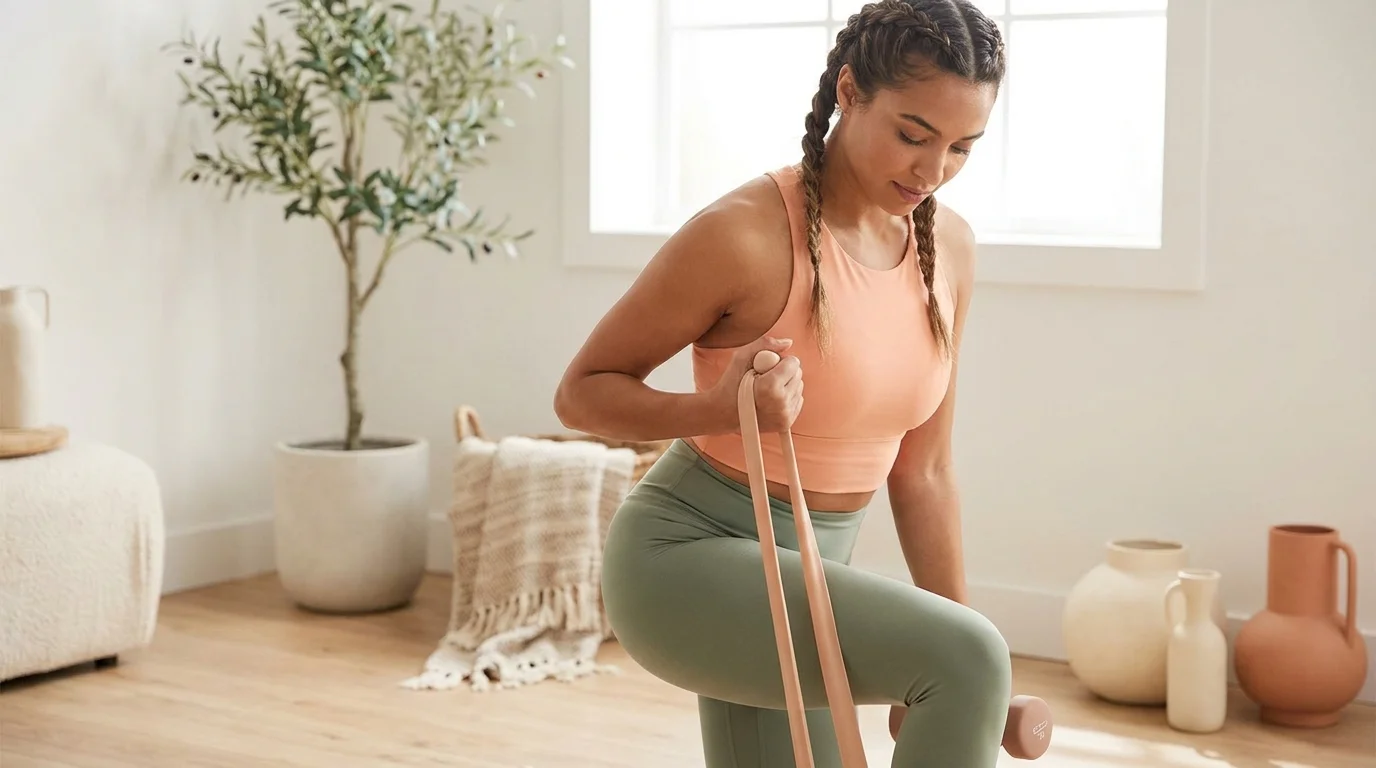
If you have PCOS, finding the right exercise approach can feel overwhelming. Cardio-heavy routines often leave you exhausted, and conflicting advice online makes it hard to know where to start. The good news: PCOS strength training offers one of the best routines for managing your symptoms from the inside out. Lifting weights with PCOS directly targets the hormonal drivers that make this condition so frustrating, including insulin resistance, elevated androgens, and chronic low-grade inflammation. For a full picture of how PCOS affects your hormones and body, start with The Complete Guide to PCOS before diving into your training plan.
This guide will walk you through exactly why resistance training works for PCOS, how to structure your workouts, and how to adjust your effort across your cycle for the best results.
Why Is Strength Training One of the Best Workouts for PCOS?
Strength training is one of the best workouts for PCOS because it improves insulin sensitivity, lowers circulating androgens, reduces cortisol stress responses, and builds lean muscle mass, all of which directly address the hormonal imbalances that drive PCOS symptoms like irregular cycles, weight gain, and acne.
PCOS is fundamentally a metabolic and hormonal condition. Up to 70% of women with PCOS have some degree of insulin resistance, meaning their cells do not respond well to insulin signals. When insulin levels stay high, the ovaries produce more testosterone, making symptoms worse. Lifting weights with PCOS helps break this cycle because muscle tissue is the primary site where glucose is taken up and used for energy. More muscle means better glucose management, lower insulin, and lower androgen production.
PCOS resistance training also has a direct anti-inflammatory effect. Research published by the National Institutes of Health confirms that progressive resistance exercise reduces markers of systemic inflammation in women with PCOS, a key factor in symptom severity. To understand more about the inflammatory component of PCOS, see our article on Inflammatory PCOS: What It Is and How to Treat It.
"Resistance training is arguably the most targeted intervention we have for PCOS because it addresses insulin resistance directly at the tissue level, without the side-effect profile of medication."
Dr. Felice Gersh, MD, Integrative Gynecologist, Integrative Medical Group of Irvine
How Does PCOS Strength Training Improve Insulin Sensitivity?
Lifting weights for PCOS improves insulin sensitivity by increasing muscle mass, which acts as a glucose sink. During and after resistance exercise, muscle cells absorb glucose independently of insulin through GLUT4 transporter activation, lowering blood sugar and reducing the hyperinsulinaemia that drives androgen overproduction in the ovaries.
Each session of lifting weights stimulates GLUT4 transporters in muscle fibres to move to the cell surface, allowing glucose uptake without needing insulin to unlock the door. This effect lasts for up to 48 hours after a workout, which is why training frequency matters so much. A 2017 systematic review in Frontiers in Physiology found that resistance training significantly improved insulin sensitivity and reduced fasting insulin in women with PCOS over 12-16 weeks.
For extra support with blood sugar balance alongside your training, pairing your routine with the strategies in our guide on Blood Sugar and PCOS: Your Cycle Guide can accelerate your results.
What Is the Best PCOS Strength Training Routine?
The best PCOS strength training routine combines compound movements (squats, deadlifts, rows, presses) performed 3-4 times per week at moderate to high intensity, with progressive overload applied gradually. This structure maximises muscle recruitment, insulin sensitivity gains, and androgen-lowering benefits without triggering cortisol spikes that can worsen PCOS symptoms.
Here is a practical weekly structure to follow:
Week Structure (3-4 Days)
- Day 1 - Lower Body Focus: Barbell squat, Romanian deadlift, walking lunges, leg press, glute bridge. 3-4 sets of 8-12 reps.
- Day 2 - Upper Body Push/Pull: Dumbbell bench press, bent-over row, overhead press, lat pulldown, face pulls. 3-4 sets of 8-12 reps.
- Day 3 - Full Body Compound: Deadlift, goblet squat, single-arm row, push-up variation, farmer carry. 3 sets of 6-10 reps at slightly heavier load.
- Day 4 (optional) - Accessory and Core: Hip thrust, step-ups, cable work, planks, pallof press. 2-3 sets of 10-15 reps.
Rest days should include low-intensity movement such as walking, stretching, or yoga rather than complete sedentary rest, which supports lymphatic flow and blood sugar stability without adding cortisol load.
Progressive Overload: The Non-Negotiable
Progressive overload means gradually increasing the challenge over time, whether through more weight, more reps, slower tempo, or reduced rest. Without it, adaptation plateaus and the metabolic benefits of PCOS resistance training diminish. Aim to increase load by roughly 2.5-5% every 1-2 weeks once you can complete all sets with good form.
How Should You Adjust PCOS Strength Training Across Your Cycle?
Women with PCOS often have irregular or anovulatory cycles, but when a cycle is present, strength training performance can be optimised by pushing harder during the follicular and ovulatory phases when oestrogen supports muscle recovery, and scaling back slightly in the luteal phase when progesterone raises core temperature and perceived effort.
During the follicular phase (roughly days 1-14 in a regular cycle), rising oestrogen levels enhance neuromuscular efficiency and pain tolerance. This is your window to set personal bests, increase load, or tackle more challenging compound lifts. The ovulatory phase is your peak power window: short, explosive movements like jump squats or heavier barbell work respond well here.
In the luteal phase, intensity can remain moderate but volume (total sets and reps) can be slightly reduced. Prioritise form over load and allow longer rest periods. If your PCOS means your cycles are unpredictable or absent, focus on how you feel day to day: energy, motivation, and recovery quality are your best guides.
"Women with PCOS who track their perceived exertion and align their heavier lifting with their higher-energy days tend to build muscle more effectively and report fewer burnout episodes than those following a rigid one-size-fits-all programme."
Dr. Stacy Sims, PhD, Exercise Physiologist and Researcher, University of Waikato
Does PCOS Resistance Training Affect Testosterone and Androgens?
PCOS resistance training can help lower free testosterone and total androgen levels over time by improving insulin sensitivity, reducing visceral fat, and downregulating ovarian androgen production. Studies show that 12 or more weeks of consistent resistance training leads to measurable reductions in total testosterone and DHEA-S in women with PCOS.
A key concern for many women is whether lifting weights will raise testosterone further. This is a common misconception. While acute testosterone rises after heavy exercise are normal and temporary in both sexes, chronic resistance training in women with PCOS has been associated with lower basal androgen levels rather than higher ones. A clinical study in Frontiers in Physiology reported significantly reduced free androgen index scores after a 12-week resistance training programme in women with PCOS.
Elevated androgens are also linked to symptoms like facial hair and acne. As your training consistency improves hormonal balance, these secondary symptoms often improve too. For more on managing androgen-related skin concerns, see our guide on PCOS Facial Hair: Natural Remedies.
Nutrition to Support Your PCOS Strength Training Routine
Training without the right nutritional support is like building a house without cement. For PCOS, several nutritional strategies stack well with resistance training:
- Prioritise protein at every meal. Aim for 1.6-2g of protein per kilogram of body weight daily. Protein supports muscle protein synthesis after lifting and helps stabilise blood sugar between sessions.
- Time carbohydrates strategically. Consuming complex carbohydrates around your workouts (1-2 hours before or within 1-2 hours after) improves glucose uptake and muscle glycogen replenishment without causing large insulin spikes.
- Do not under-eat. Chronic caloric restriction raises cortisol, suppresses thyroid function, and worsens the hormonal environment in PCOS. Eating enough to support training is essential, not optional.
- Anti-inflammatory foods matter. Omega-3-rich foods, leafy greens, berries, and olive oil reduce the chronic inflammation that underlies PCOS pathology and supports muscle recovery.
What Mistakes Should You Avoid With PCOS Strength Training?
The most common mistakes women with PCOS make with strength training include training too frequently without adequate recovery, combining excessive cardio with lifting (which elevates cortisol), under-eating to try to lose weight faster, and skipping progressive overload, all of which can worsen the hormonal environment rather than improve it.
Cortisol is a particular concern. PCOS is already associated with dysregulated cortisol patterns, and excessive training stress without recovery amplifies this. Keeping sessions to 45-60 minutes, sleeping 7-9 hours, and including rest days protects the hormonal gains you are working hard to build.
HIIT done in excess is another common trap. While short bouts of high-intensity interval training have their place (especially in the follicular phase), excessive HIIT loads the HPA axis and can spike androgens acutely in PCOS. Resistance training as the foundation, supplemented by moderate cardio, is a more sustainable approach.
Key Statistics and Sources
- Up to 70% of women with PCOS have insulin resistance, making metabolic interventions like resistance training a first-line approach. (NIH, 2019)
- 12-16 weeks of resistance training significantly reduced fasting insulin and free androgen index in women with PCOS. (Frontiers in Physiology, 2017)
- Muscle tissue accounts for up to 80% of insulin-stimulated glucose uptake, making building muscle the most direct way to address insulin resistance. (NIDDK, NIH)
- Women with PCOS who combined resistance training with dietary changes saw a 30% greater reduction in testosterone than those using diet alone. (Frontiers in Physiology, 2017)
- PCOS affects an estimated 8-13% of women of reproductive age globally, making it the most common hormonal disorder in women. (WHO)
- Progressive resistance training for 12 weeks improved menstrual regularity in 31% of previously anovulatory women with PCOS in one clinical trial. (NIH, 2019)