What Is Seed Cycling?
Seed cycling is a food-based practice that involves eating specific seeds during each half of your menstrual cycle to gently support your natural hormone rhythms. The idea is simple: certain seeds contain lignans, fatty acids, and micronutrients that interact with estrogen and progesterone metabolism in ways that may help smooth out the hormonal shifts that drive PMS, irregular cycles, and low energy.
It is not a magic cure. It is not a pharmaceutical intervention. But for many people, it is a tangible, low-risk daily practice that keeps them connected to their cycle and, over time, may meaningfully shift how they feel across the month.
Here is what the science says, how to actually do it, and what to realistically expect.
The Two Phases, Four Seeds
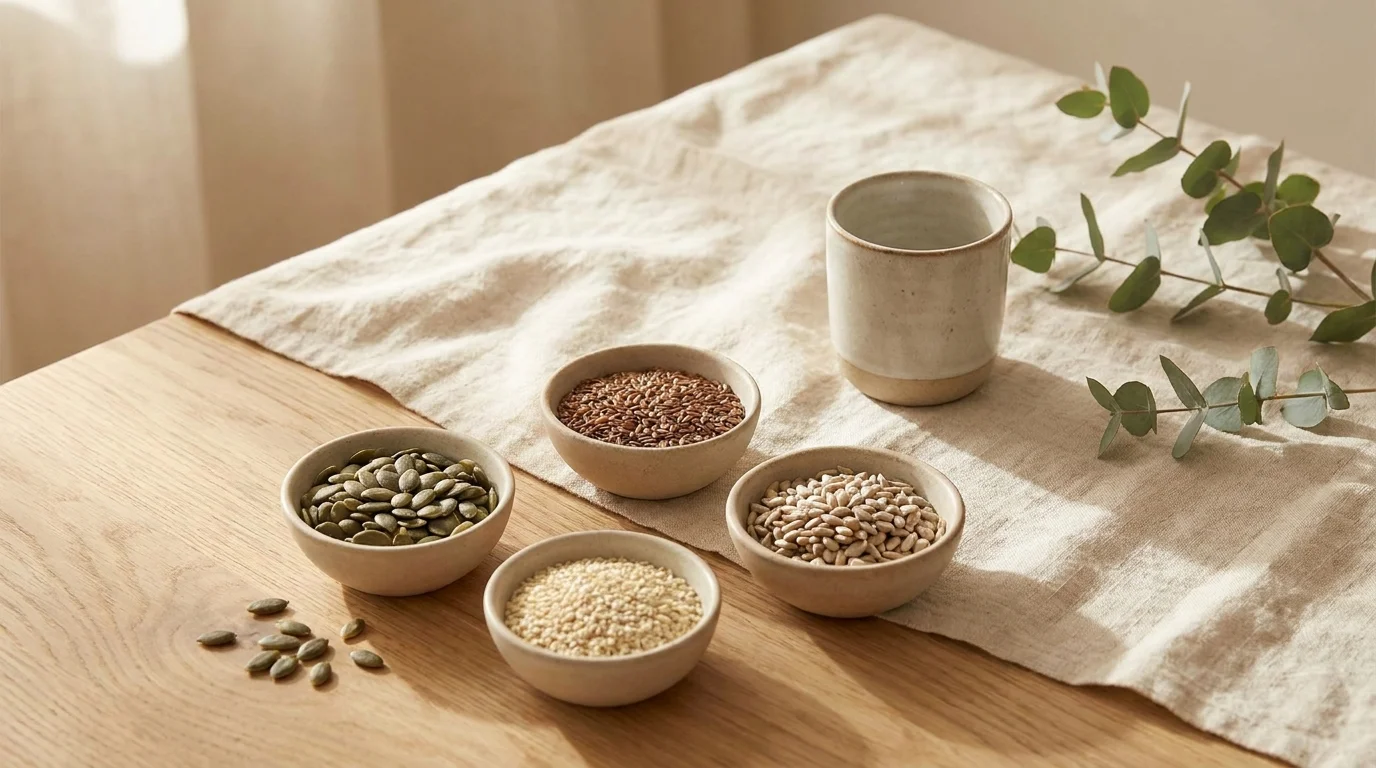
Seed cycling maps onto the two broad halves of your cycle: the follicular phase (day 1 through ovulation, roughly days 1-14) and the luteal phase (post-ovulation through the end of your cycle, roughly days 15-28). Each phase calls for a different seed combination.
Follicular Phase: Flax and Pumpkin Seeds
During the follicular phase, estrogen rises to trigger follicle development and, eventually, ovulation. The goal of seed cycling in this phase is to support healthy estrogen activity without tipping into excess.
- Flaxseeds are rich in lignans, plant compounds that bind to estrogen receptors and act as weak phytoestrogens. Crucially, they also support the clearance of excess estrogen through the gut, which matters enormously for hormone balance. Research published via the NIH has shown that flaxseed lignans can modulate estrogen metabolism and influence urinary estrogen ratios.
- Pumpkin seeds are one of the richest plant sources of zinc, a mineral critical for progesterone production (which you will need in the second half of your cycle) and for the healthy maturation of the follicle developing right now.
Luteal Phase: Sesame and Sunflower Seeds
After ovulation, the corpus luteum takes over and progesterone becomes the dominant hormone. The goal shifts to supporting adequate progesterone and helping your body use it effectively.
- Sesame seeds also contain lignans (specifically sesamin and sesamolin) that have been studied for their role in hormone metabolism. They are also a good source of zinc and selenium, both of which support thyroid and ovarian function.
- Sunflower seeds are particularly high in vitamin E and selenium. Vitamin E has been studied in the context of progesterone support, and the NIH Office of Dietary Supplements notes its role as an antioxidant that protects cells involved in hormone production, including those in the corpus luteum.
"Lignans from flaxseeds can influence estrogen metabolism at multiple points, including how estrogen is absorbed, circulated, and excreted. For women with estrogen dominance or PMS symptoms, this kind of dietary modulation is worth taking seriously as a first-line support strategy."
Dr. Lara Briden, ND, Naturopathic Doctor and Author, Period Repair Manual
The Nutritional Science Behind It
While large-scale randomised controlled trials on seed cycling as a protocol are limited, the individual seeds involved have solid research behind them.
Lignans and Estrogen Metabolism
Lignans are a type of polyphenol that your gut bacteria convert into enterolignans: enterodiol and enterolactone. These compounds can bind to estrogen receptors and, depending on the hormonal environment, act as either weak estrogens or anti-estrogens. This adaptogenic quality is part of why flaxseeds are considered particularly valuable during the follicular phase.
Harvard T.H. Chan School of Public Health highlights flaxseed as a source of alpha-linolenic acid (an omega-3 fatty acid), lignans, and fibre, all of which contribute to cardiovascular and hormonal health.
Essential Fatty Acids and Prostaglandins
All four seeds provide essential fatty acids. Flax is rich in omega-3 ALA, while sunflower and pumpkin seeds provide omega-6 linoleic acid. The ratio of omega-3 to omega-6 fatty acids influences the type of prostaglandins your body produces during menstruation. Pro-inflammatory prostaglandins (from excess omega-6) are associated with more painful periods, while omega-3-derived prostaglandins tend to be anti-inflammatory. Seed cycling, when done alongside an overall balanced diet, can contribute to a healthier fatty acid ratio.
Zinc, Selenium, and the Ovarian Connection
Zinc is required for the synthesis of follicle-stimulating hormone (FSH) and luteinising hormone (LH), both of which drive ovulation. Selenium supports thyroid function, and since thyroid hormones regulate the entire endocrine system, selenium deficiency can have downstream effects on cycle regularity. Pumpkin and sesame seeds deliver meaningful amounts of both minerals in a highly bioavailable form.
"Micronutrient support through whole foods is one of the most sustainable and well-tolerated approaches to hormone health. Seeds are nutritionally dense, anti-inflammatory, and fibre-rich. Even if the specific seed cycling protocol needs more clinical study, the dietary pattern it encourages is genuinely beneficial."
Dr. Aviva Romm, MD, Integrative Physician, Herbalist, Author, Yale School of Medicine
How to Actually Do It
The protocol is straightforward, but consistency matters. Think of it as a daily ritual rather than a strict prescription.
The Daily Dose
The standard recommendation is 1-2 tablespoons of each seed per day, freshly ground where possible (especially for flaxseeds, which are more bioavailable ground than whole).
- Days 1-14 (Follicular): 1-2 tbsp ground flaxseed + 1-2 tbsp pumpkin seeds
- Days 15-28 (Luteal): 1-2 tbsp sesame seeds + 1-2 tbsp sunflower seeds
- Grind flaxseeds fresh or buy pre-ground and store in the fridge
- Add to smoothies, yoghurt, oatmeal, salads, or energy balls
- Allow 3 full cycles before evaluating results
Practical Ways to Use Your Seeds
The biggest barrier to seed cycling is remembering to do it. Here are some approaches that work:
- Smoothies: Blend your seeds directly in. Flax and pumpkin disappear easily into a fruit smoothie.
- Overnight oats or porridge: Stir in at the end. Sunflower and sesame seeds add a pleasant texture.
- Seed cycling energy balls: Batch-make fortnightly with dates, oats, nut butter, and your current phase seeds. Store in the fridge for a grab-and-go option.
- On salads or grain bowls: Sprinkle over the top just before eating.
- In homemade bread or crackers: Fold into the dough during baking.
Who May Benefit Most
Seed cycling tends to show the most noticeable results for people who are experiencing:
- PMS symptoms like bloating, breast tenderness, mood shifts, and irritability in the week before their period
- Irregular cycles or cycles that are slowly reregulating after coming off hormonal contraception
- Signs of estrogen dominance such as heavy periods, mid-cycle spotting, or persistent acne
- Low progesterone symptoms like short luteal phases, anxiety in the second half of the cycle, or difficulty maintaining early pregnancy
- PCOS, particularly where insulin resistance and inflammation are factors (the omega-3 and fibre content of these seeds is particularly relevant here)
If your cycles are already regular and symptom-free, you may notice subtler effects, but the nutritional benefits of eating these seeds daily remain real regardless.
What to Realistically Expect
Seed cycling is a slow practice. Hormones shift gradually, and dietary changes work on a longer timeline than supplements or medications. Most practitioners and people who have used seed cycling consistently suggest allowing at least 3 full menstrual cycles before drawing conclusions.
Common early observations (within the first 1-2 cycles) include improved digestion thanks to the added fibre, slightly less intense PMS symptoms, and feeling more connected to the rhythm of your cycle simply through the act of paying attention to it. By cycles 3-4, some people notice more meaningful shifts: shorter, lighter periods, reduced breast tenderness, or more stable mood in the luteal phase.
It is also worth noting that seed cycling works best as part of a broader approach to hormone health, not as a standalone fix. Pairing it with stable blood sugar, adequate sleep, and stress management will always produce better results than seeds alone.
A Note on Irregular Cycles
If you do not have a predictable cycle, you can still use seed cycling. Many practitioners suggest cycling based on the moon: eat flax and pumpkin seeds from the new moon to the full moon, then switch to sesame and sunflower from the full moon to the next new moon. While the lunar calendar has no direct biological relationship to your hormones, it provides a consistent external rhythm to work with until your own cycle becomes more predictable.
If you are postpartum, breastfeeding, or in perimenopause, seed cycling can still be a useful nutritional practice. The seeds themselves are supportive and safe regardless of cycle regularity; it is simply the timing that may need to be adapted.
- Flaxseed lignans have been shown to reduce urinary estrogen metabolite ratios, a marker of improved estrogen metabolism. NIH/PubMed
- Zinc deficiency is associated with impaired ovarian function and reduced progesterone production in women of reproductive age. NIH Office of Dietary Supplements
- Vitamin E supplementation has been associated with improvements in progesterone levels and luteal phase adequacy in some studies. NIH Office of Dietary Supplements
- Selenium deficiency affects thyroid hormone conversion and has downstream effects on reproductive health and cycle regularity. NIH Office of Dietary Supplements
- Dietary lignans from flaxseed and sesame are converted by gut bacteria into biologically active enterolignans that interact with estrogen receptors. Harvard T.H. Chan School of Public Health