The Quiet Deficiency That Could Explain Everything
You eat well, you sleep (mostly), and you exercise. Yet you are exhausted, your hair is thinning, your period leaves you wiped out for days, and your brain fog is relentless in the week before your period. Sound familiar? For millions of women, the missing piece is not a lack of willpower or a broken thyroid. It is ferritin: the protein your body uses to store iron.
Ferritin is not quite the same as iron itself. Think of iron as the cash in your wallet and ferritin as your savings account. You can feel financially stressed even if your current balance looks fine, if your savings have been quietly depleted. The same logic applies here. Standard blood tests often check serum iron or haemoglobin, but ferritin tells the deeper story, and many women are walking around with ferritin levels so low that their bodies are struggling to function, yet technically remaining within the "normal" reference range.
This article unpacks what ferritin actually does, why your menstrual cycle puts you at particular risk, and what you can do about it.
What Is Ferritin and Why Does It Matter?
Ferritin is an intracellular protein that stores iron and releases it in a controlled way. When your ferritin is adequate, your body can make haemoglobin (the oxygen-carrying protein in red blood cells), produce thyroid hormones efficiently, support dopamine synthesis, and maintain healthy hair follicle activity. When ferritin drops, all of those processes suffer, often before a standard full blood count raises any flags.
Most laboratory reference ranges flag ferritin as "low" only when it falls below 12 to 15 micrograms per litre (mcg/L). But a growing body of research suggests that symptoms, particularly fatigue and hair loss, begin appearing at levels below 30 to 50 mcg/L. Some functional medicine practitioners aim for ferritin levels of 70 to 100 mcg/L for optimal wellbeing in menstruating women.
"Many women are told their iron is normal when their ferritin is 14. That number is technically within range but it is nowhere near optimal. We routinely see dramatic improvements in energy and mood when ferritin climbs above 50 mcg/L."
Dr. Jolene Brighten, NMD, Functional Medicine Physician and Author, BrightenWellness.com
Your Cycle Is a Monthly Iron Challenge
The most obvious reason women are disproportionately affected by low ferritin is menstruation. With every period, you lose blood, and with blood you lose iron. The average menstrual cycle involves a blood loss of around 30 to 40 millilitres, but for women with heavy periods (clinically defined as more than 80 millilitres per cycle), iron losses can be substantial enough to create a cumulative deficit over months and years.
Research published in the Journal of Nutrition found that menstruating women have significantly higher rates of iron depletion than men of the same age, with heavy menstrual bleeding identified as the leading cause of iron deficiency in premenopausal women globally.
But the cycle connection goes beyond blood loss. Oestrogen and progesterone fluctuations across your cycle influence how effectively your gut absorbs iron. Oestrogen appears to mildly suppress hepcidin, a hormone that regulates iron absorption, which means your body may be slightly better at absorbing dietary iron in the first half of your cycle. Progesterone's role is less clear but some research suggests it can affect inflammatory pathways that influence iron metabolism.
How Low Ferritin Affects Each Phase of Your Cycle
Menstrual Phase (Days 1-5)
This is when ferritin takes its biggest hit. If your stores are already borderline, losing blood during your period can push you into the symptomatic zone. Fatigue, dizziness on standing, and heavy brain fog in the first few days of your period are classic signs that ferritin is struggling to keep up with demand.
Follicular Phase (Days 6-13)
Rising oestrogen generally provides an energy lift here, but if ferritin is low, you may not feel that characteristic follicular-phase bounce. Oestrogen supports iron absorption in the gut, so this is actually a good time to focus on iron-rich foods. Dopamine synthesis also depends on adequate iron, which means low ferritin can blunt that rising motivation and focus that the follicular phase is known for.
Ovulatory Phase (Days 14-16)
Energy, confidence, and clarity tend to peak at ovulation thanks to surging oestrogen and a brief testosterone spike. Women with low ferritin often report that this window feels shorter or less energising than expected. Iron is also essential for the production of thyroid hormones, and even mild deficiency can blunt the metabolic energy boost that normally accompanies this phase.
Luteal Phase (Days 17-28)
This is where low ferritin tends to cause the most visible disruption. As oestrogen drops after ovulation and progesterone rises, the body's demand for nutrients increases. Iron is needed for serotonin synthesis (via the conversion of tryptophan), so low ferritin during the luteal phase can worsen low mood, anxiety, and the emotional sensitivity that many women already experience due to progesterone's natural sedative effects. PMS symptoms are consistently worse in women with depleted iron stores.
"Iron deficiency does not just cause anaemia. It disrupts neurotransmitter production, thyroid function, and energy metabolism in ways that directly map onto what women describe as severe PMS or burnout. Ferritin testing should be standard in any woman presenting with these complaints."
Dr. Natalie Crawford, MD, Reproductive Endocrinologist and Infertility Specialist, Fora Health
Symptoms That Might Actually Be Low Ferritin
Because ferritin depletion is not the same as full anaemia, the symptoms can be subtle and easy to dismiss or attribute to other causes. Here is what to watch for:
- Persistent fatigue that does not resolve with sleep
- Hair shedding or thinning, particularly diffuse loss across the scalp
- Cold hands and feet, even in warm environments
- Restless legs, particularly at night
- Difficulty concentrating and worsening brain fog in the luteal phase
- Shortness of breath on mild exertion
- Low mood and increased anxiety, especially premenstrually
- Pale inner eyelids or gums
- Cravings for non-food items (ice, clay, dirt) - a condition called pica
- Worsening PMS or significantly heavier periods over time
According to the National Institutes of Health Office of Dietary Supplements, iron deficiency is the most common nutritional deficiency worldwide, and women of reproductive age are among the highest-risk groups.
Getting the Right Test
If you suspect low ferritin, the key is to ask specifically for a serum ferritin test. It is not always included in a routine blood panel. Ideally, you want to know:
- Serum ferritin (iron storage - aim for 50 to 100 mcg/L)
- Serum iron
- Transferrin saturation (how much iron is being carried in the blood)
- Full blood count including haemoglobin and MCV (mean corpuscular volume)
Timing matters too. Ferritin is an acute-phase reactant, meaning it can appear falsely elevated when you are fighting an infection or dealing with inflammation. Testing during a calm window, when you are not ill, gives the most accurate picture. Many practitioners recommend testing in the early follicular phase, around days 5 to 7 of your cycle, for the most useful baseline.
How to Raise Ferritin Through Food
The body absorbs two forms of dietary iron: haem iron from animal sources, and non-haem iron from plant sources. Haem iron (found in red meat, chicken, and fish) is absorbed at a rate of around 15 to 35 percent. Non-haem iron (from lentils, spinach, tofu, and fortified cereals) is absorbed at just 2 to 20 percent, making it considerably harder to replete stores on a plant-based diet without strategic pairing.
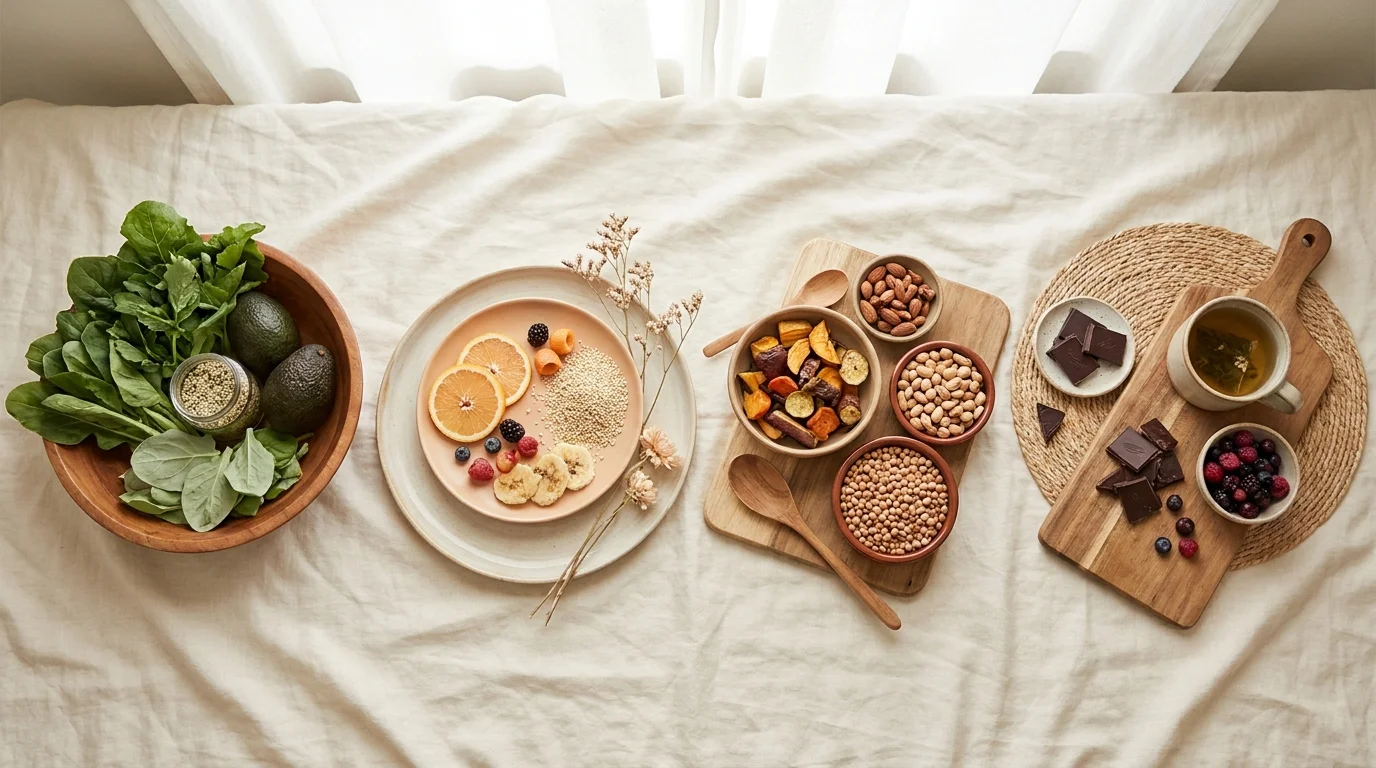
Top food sources of iron
- Beef liver (one of the richest sources available)
- Red meat (beef, lamb)
- Oysters and clams
- Dark poultry meat
- Lentils and legumes
- Pumpkin seeds
- Dark leafy greens (spinach, chard)
- Fortified cereals and breads
- Tofu and tempeh
- Dark chocolate (surprisingly useful)
The vitamin C pairing
Pairing non-haem iron sources with vitamin C dramatically increases absorption. Squeezing lemon over lentils, eating bell peppers alongside spinach, or having a small glass of orange juice with your iron-rich meal can increase absorption by up to three times. A review in the American Journal of Clinical Nutrition confirmed that ascorbic acid (vitamin C) is one of the most potent enhancers of non-haem iron absorption available.
What to avoid around iron-rich meals
Certain compounds inhibit iron absorption and are worth spacing away from your iron-rich meals by at least an hour:
- Tannins in tea and coffee
- Phytates in raw grains and legumes (soaking and cooking reduces these)
- Calcium in dairy (competing for the same absorption pathway)
- Polyphenols in certain herbal teas
Supplementing Iron: What You Need to Know
If food alone is not moving your ferritin, supplementation may be necessary, but it comes with nuance. Not all iron supplements are equal, and the wrong form can cause significant digestive side effects, leading many women to abandon them before they see results.
Ferrous bisglycinate (iron glycinate) is widely considered the gentlest and most bioavailable form, with lower rates of constipation and nausea compared to ferrous sulphate. Taking iron supplements on alternate days (rather than daily) has been shown in some studies to improve absorption by allowing hepcidin levels to reset between doses.
Never supplement iron without confirmed testing. Iron overload is a genuine risk, particularly in women who carry the HFE gene variant associated with haemochromatosis, and excess iron is pro-oxidative, meaning it can increase cellular damage rather than reduce it.
Key Takeaway
Low ferritin is one of the most overlooked contributors to cycle-related fatigue, worsening PMS, hair loss, and poor focus. If you are eating well and sleeping reasonably but still feel exhausted, especially around your period, ask your doctor for a specific serum ferritin test. Optimal is 50 to 100 mcg/L, not just "within normal range."
Supporting Ferritin Across Your Cycle
Rather than treating iron in isolation, think of ferritin support as a cycle-wide strategy:
- Menstrual phase: Focus on haem iron sources post-bleed. Prioritise red meat, liver, or shellfish in the days following your period to begin replenishing losses.
- Follicular phase: Oestrogen supports absorption, making this a prime window for iron-rich meals with vitamin C pairings.
- Luteal phase: Maintain iron intake to support serotonin production and reduce PMS severity. Avoid excess tea and coffee around meals.
- All phases: Manage inflammation, as chronic low-grade inflammation raises hepcidin and blocks iron absorption even when dietary intake is adequate.
Key Statistics and Sources
- Approximately 30% of the global population has iron deficiency, making it the most common nutritional deficiency worldwide - World Health Organization
- Women of reproductive age are 10 times more likely to be iron deficient than men - NIH Office of Dietary Supplements
- Ferritin levels below 50 mcg/L are associated with fatigue and hair loss even in the absence of anaemia - Journal of Nutrition
- Vitamin C can increase non-haem iron absorption by up to 300% when consumed in the same meal - American Journal of Clinical Nutrition
- Heavy menstrual bleeding affects 1 in 3 women and is the leading cause of iron deficiency in premenopausal women - NCBI Bookshelf
- Alternate-day iron dosing has been shown to improve fractional iron absorption compared to daily dosing in some populations - Journal of Clinical Investigation