If you have ever felt unusually clumsy in the days before your period, rolled an ankle mid-run when you could have sworn you were being careful, or noticed that your yoga balance poses feel wildly inconsistent from week to week, you are not imagining things. Your balance, coordination, and proprioception genuinely shift across your menstrual cycle, driven by the same hormones that influence your mood, skin, and energy.
Understanding this connection is not just interesting biology. It is actionable information that can help you train smarter, reduce injury risk, and build a fitness practice that works with your body rather than against it.
What Is Proprioception and Why Does It Matter?
Proprioception is your body's ability to sense its own position, movement, and force in space, without looking. It is the hidden sixth sense that allows you to walk without watching your feet, catch yourself when you stumble, and perform precise athletic movements. When proprioception is compromised, injury risk rises significantly.
Your proprioceptive system relies on receptors in your muscles, tendons, ligaments, and joints that constantly send signals to your brain. These receptors are exquisitely sensitive, and research has shown they are also responsive to hormonal fluctuations. Estrogen and progesterone both have receptors in connective tissue, meaning your ligaments and tendons are not immune to the hormonal swings of your cycle.
"The neuromuscular system does not operate in isolation from reproductive hormones. We see measurable differences in joint position sense, reaction time, and muscle activation patterns depending on where a woman is in her cycle."
Dr. Sandra Hunter, Professor of Exercise Science, Marquette University
How Do Estrogen and Progesterone Affect Balance?
Estrogen generally supports neuromuscular control and ligament stiffness at moderate levels, while high progesterone in the luteal phase can increase joint laxity and reduce proprioceptive accuracy. This creates a predictable window each month where balance and coordination are at their most vulnerable.
Research published by the National Center for Biotechnology Information found that estrogen receptors are present in the anterior cruciate ligament (ACL), and that ligament stiffness changes measurably across the menstrual cycle. During the late follicular phase, when estrogen peaks just before ovulation, ligament laxity increases, and this is a period of elevated ACL injury risk, particularly in sports involving pivoting and jumping.
Progesterone adds another layer. As it rises after ovulation and dominates the luteal phase, it compounds the laxity effect. Joint position sense, which is the ability to detect where a limb is in space, becomes less accurate. This does not mean you should stop exercising in your luteal phase. It means you should exercise differently.
Which Phase of Your Cycle Is Highest Risk for Injury?
The late follicular phase and ovulatory window carry the highest documented ACL and ankle sprain risk, largely because estrogen peaks rapidly and ligament laxity increases before the neuromuscular system fully adapts. The late luteal phase also carries elevated risk due to progesterone-driven proprioceptive changes and fatigue.
A landmark study from the American Journal of Sports Medicine tracked female athletes and found that ACL injuries occurred at a significantly higher rate during the ovulatory and late follicular phases compared to the menstrual and early follicular phases. The mechanism is clear: rising estrogen softens ligamentous tissue faster than the neuromuscular system can compensate.
This does not mean you are destined for injury every cycle. It means awareness and strategic training adjustments can genuinely reduce your risk.
Key Takeaway
The highest injury-risk windows are around ovulation (days 12-16 in a 28-day cycle) and the late luteal phase (days 24-28). This is when neuromuscular training, warm-up quality, and load management matter most.
What Does Balance Training Look Like in Each Phase?
Each phase of your cycle calls for a different emphasis in balance and proprioceptive training. The menstrual and early follicular phases are ideal for rebuilding foundational movement patterns, while the ovulatory phase benefits from added focus on stability work before peak athletic output. The luteal phase calls for controlled, deliberate movement with enhanced warm-ups.
Menstrual Phase (Days 1-5): Reset and Restore
Estrogen and progesterone are at their lowest. Energy may be reduced, but proprioception is actually relatively stable during this window. This is a good time for gentle, intentional balance work rather than high-demand athletic tasks.
- Single-leg standing with eyes closed (30-second holds)
- Slow heel-to-toe walking along a line
- Supported warrior poses in yoga
- Foam rolling to improve sensory input to muscles
Follicular Phase (Days 6-13): Build Neuromuscular Foundations
Rising estrogen improves mood, energy, and muscle recovery. Proprioception begins to sharpen. This is your window to build the neuromuscular foundations that will protect you when estrogen peaks dramatically at ovulation.
- Single-leg Romanian deadlifts
- Bosu ball squats and lunges
- Lateral band walks with intention
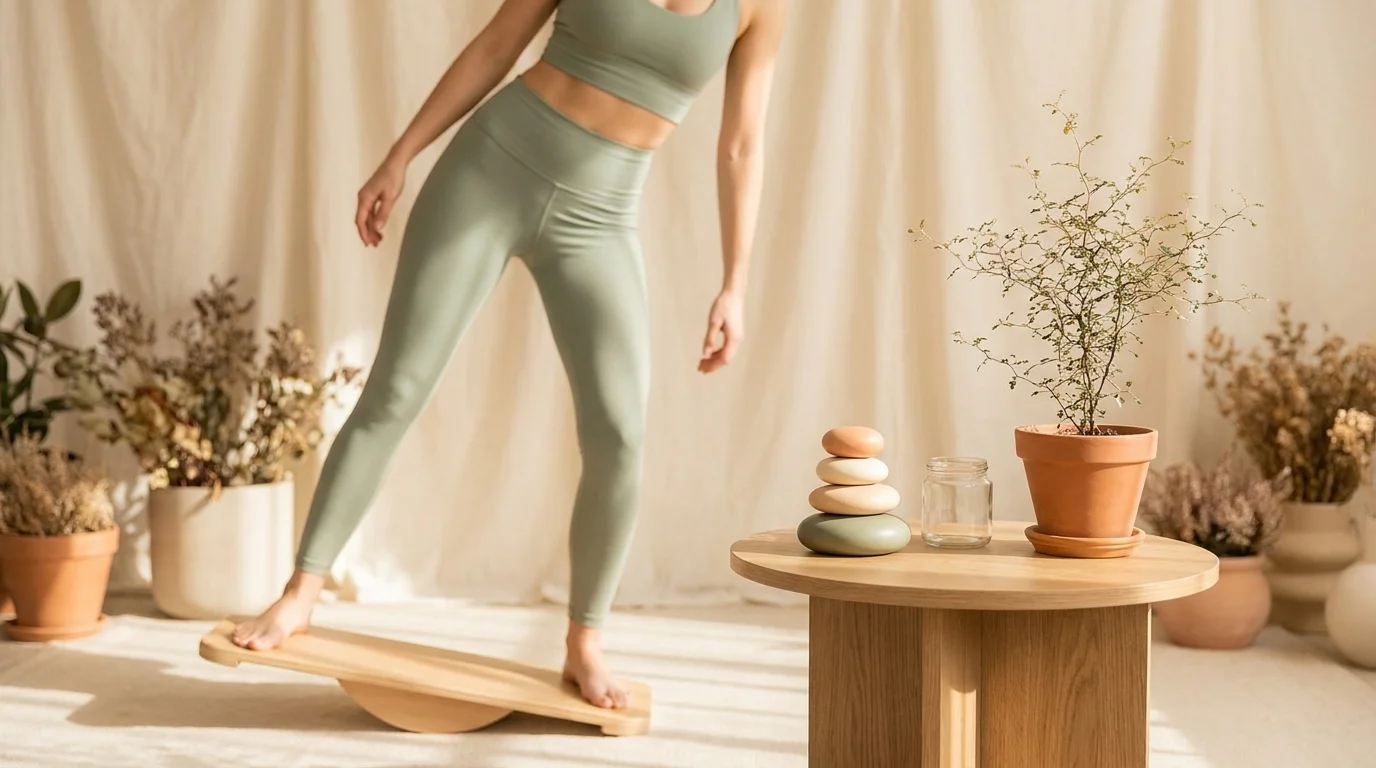
- Balance board progressions
- Agility ladder drills at moderate intensity
"Women who consistently train proprioception across the full cycle, not just when they feel good, have measurably better joint position sense and lower injury rates over time. The follicular phase is the best time to invest in that training because the body is most responsive to neuromuscular adaptation."
Dr. Kirsty Elliott-Sale, Professor of Female Physiology, Nottingham Trent University
Ovulatory Phase (Days 14-16): Power With Precision
This is when you feel strongest and most coordinated neurologically, but ligament laxity is at its monthly peak. Think of this phase as high power with high responsibility. You can push your athletic output, but your warm-up and landing mechanics need extra attention.
- Extend your warm-up by 5-10 minutes
- Include specific landing drills before jumping or pivoting sports
- Add perturbation training: have a partner lightly push you while you balance
- Focus on controlled deceleration, not just acceleration
- Include hip and glute activation to reduce knee valgus (inward collapse) risk
A study from Frontiers in Physiology confirmed that neuromuscular training programs that specifically target landing mechanics and hip control significantly reduce ACL injury risk in female athletes, with the greatest benefit seen when training is consistent across all cycle phases.
Luteal Phase (Days 17-28): Slow Down and Tune In
Progesterone dominates. Joint laxity remains elevated. Fatigue often increases in the late luteal phase, and research shows that fatigue itself further impairs proprioception, creating a compounding effect. This is not the phase to push personal records on high-risk movements.
- Prioritise slower, more controlled versions of familiar exercises
- Use mirrors or video feedback to check your alignment
- Reduce load on single-leg and pivoting movements
- Include more floor-based core and stability work
- Increase warm-up duration and include dynamic joint mobility
Luteal Phase Balance Tips
If you feel clumsy or off-balance in your late luteal phase, that is a physiological signal, not a personal failing. Honour it by modifying rather than pushing through high-risk movements. Your body is telling you something accurate.
Does the Menstrual Cycle Affect Balance in Everyday Life, Not Just Sport?
Yes. The hormonal shifts that affect athletic proprioception also affect everyday balance tasks, from walking on uneven ground to navigating stairs in the dark. Women in perimenopause experience this even more acutely, as declining estrogen affects vestibular function and inner ear balance mechanisms more persistently.
For everyday balance, especially in the luteal and premenstrual phases, some practical adjustments make a real difference:
- Wear supportive footwear rather than flat or unstable shoes
- Take extra care on wet or uneven surfaces
- Avoid rushing on stairs or in unfamiliar environments
- Consider adding 5 minutes of daily balance practice, like standing on one leg while brushing your teeth
Can You Train Your Balance to Reduce Cycle-Related Risk?
Absolutely. Neuromuscular training is one of the most evidence-backed interventions for reducing injury risk in women, and its benefits accumulate over time and across cycle phases. Consistent proprioceptive training literally rewires the nervous system to compensate better for ligament laxity.
The key principles of effective cycle-aware balance training:
- Consistency over cycles: Train balance in every phase, not just when you feel sharp. The follicular phase builds capacity; the luteal phase tests and maintains it.
- Progressive challenge: Advance from stable to unstable surfaces, eyes open to eyes closed, bilateral to unilateral, slow to fast over weeks and months.
- Phase-specific loading: Reduce load and speed during high-laxity windows (ovulation and late luteal) while maintaining movement quality.
- Fatigue management: Never skip the warm-up during the luteal phase. Fatigued proprioception plus hormonal laxity is where most non-contact injuries occur.
What About Perimenopause and Balance?
Perimenopause brings erratic estrogen fluctuations that increasingly affect vestibular function, the inner ear system responsible for spatial orientation. Many women in their 40s notice new episodes of dizziness, stumbling, or feeling "off" that are directly connected to these hormonal shifts.
As estrogen declines, its protective effects on the nervous system and musculoskeletal tissue become less consistent. This makes balance training even more important, not less, as women move through perimenopause and beyond. Strength training, which preserves the muscle mass that supports joint stability, and regular balance-specific work are both strongly recommended by exercise physiology guidelines for this life stage.
Perimenopause Balance Action Plan
- Include single-leg work 2-3 times per week
- Practice tandem stance and eyes-closed balance daily
- Prioritise hip and glute strength to stabilise knees and ankles
- Discuss any new dizziness or significant balance changes with your doctor
Key Statistics and Sources
- Female athletes are 2-8 times more likely to sustain ACL injuries than male athletes, with hormonal factors contributing significantly. AJSM, NIH
- ACL injury rates in women peak during the ovulatory phase, when estrogen reaches its monthly high and ligament laxity is greatest. NCBI Research Review
- Neuromuscular training programs reduce ACL injury risk in female athletes by 52-82% across studies. Frontiers in Physiology
- Joint position sense accuracy decreases measurably during the late luteal phase compared to the follicular phase in healthy cycling women. NCBI
- Estrogen receptors have been identified in ACL tissue, confirming a direct hormonal influence on ligament mechanics. NCBI
- Women in perimenopause show measurable declines in postural stability linked to falling estrogen levels affecting vestibular and neuromuscular function. Frontiers in Physiology
Your balance is not a fixed trait. It is a dynamic, hormonally influenced capacity that shifts throughout your cycle and across your life. The good news is that knowing this gives you an edge. Train with your cycle, not despite it, and you will build the kind of neuromuscular resilience that protects you in every phase.