If you have ever rolled your ankle mid-run two weeks before your period, or noticed that your hips feel unusually stiff on the first day of your cycle, you are not imagining things. Your hormones have a profound and measurable effect on your connective tissue, muscle function, and injury risk, and understanding that connection could genuinely change how you train, recover, and move through the world.
Most sports science research has historically been conducted on men, but a growing body of evidence is now making it clear: the female body is not a smaller male body. The hormonal fluctuations across your menstrual cycle actively reshape how your ligaments behave, how quickly your muscles repair, and how much force your joints can safely absorb. This is not a weakness. It is information, and once you have it, you can work with your biology rather than against it.
Why Hormones and Connective Tissue Are Deeply Connected
Ligaments, tendons, and cartilage are not static structures. They contain receptors for estrogen, progesterone, and relaxin, meaning they actively respond to shifts in your hormonal environment throughout the month. This was once considered a niche finding in obstetric research, but it has since been confirmed across dozens of studies in sports medicine and orthopedics.
Estrogen, in particular, has a complex relationship with collagen, the protein that gives connective tissue its strength and elasticity. At moderate levels, estrogen supports collagen synthesis and tissue repair. But at peak levels, particularly around ovulation, it can also increase ligament laxity, making joints more flexible but also more vulnerable to strain and sprain.
"The anterior cruciate ligament is not an isolated structure. It is a hormone-responsive tissue, and ignoring that fact means ignoring one of the most modifiable risk factors for ACL injury in female athletes."
- Dr. Letha Griffin, MD, Sports Medicine Physician, Peachtree Orthopaedic Clinic
This is not abstract theory. Research published through the National Institutes of Health has found that female athletes are two to eight times more likely than male athletes to sustain ACL injuries, and that hormonal fluctuations are considered a significant contributing factor. Injury rates in studies cluster around the preovulatory phase, when estrogen is surging and ligament laxity is at its highest.
The Four Phases: What Is Actually Happening to Your Body
Menstrual Phase: Inflammation, Prostaglandins, and Stiffness
During menstruation, your body releases prostaglandins to trigger uterine contractions. These same compounds can create a low-grade inflammatory state that extends beyond the uterus. For some people, this shows up as joint stiffness, heightened sensitivity to pain, or general muscle heaviness, particularly in the lower back, hips, and legs.
Estrogen and progesterone are both at their lowest, which means collagen synthesis slows and your tissues are not in an optimal repair state. High-impact training and heavy loading during this phase can feel harder than usual, and that perception is physiologically valid. This is a good phase for gentle movement, mobility work, and light loads rather than personal bests.
Follicular Phase: Rising Estrogen, Rising Resilience
As estrogen begins its climb through the follicular phase, your body enters what many researchers describe as an anabolic window. Muscle protein synthesis becomes more efficient, tissue repair accelerates, and your nervous system becomes more responsive. Many people notice that workouts feel easier, recovery is faster, and motivation is genuinely higher during this phase.
This is a great time to push load, try new skills, and tackle higher-intensity sessions. However, it is worth noting that as you approach ovulation, the rapid rise in estrogen begins to increase ligament laxity, so warming up thoroughly and not skipping stability work matters more than ever as this phase progresses.
"We now know that muscle adaptations to strength training are not uniform across the month. The follicular phase appears to be the most productive time for building lean mass, largely because estrogen enhances the anabolic response to resistance training."
- Dr. Stacy Sims, PhD, Exercise Physiologist and Researcher, AUT University
Ovulatory Phase: Peak Power, Peak Vulnerability
Ovulation brings the highest estrogen levels of your cycle, and with them, peak physical performance potential for many people: strength output, coordination, and cardiovascular capacity are all at or near their best. But this is also the phase where joint laxity peaks.
A study published in the American Journal of Sports Medicine found that ACL laxity was significantly greater during the preovulatory phase compared to other phases of the cycle, corresponding with peak estrogen concentrations. The practical implication is not to avoid training during ovulation, but to be deliberate about neuromuscular control, landing mechanics, and joint stability during this window.
Warm up properly. Prioritise single-leg stability drills if you play sport. Be conscious of fatigue-related form breakdown. Your joints are more mobile right now, and that requires more muscular support to compensate.
Luteal Phase: Progesterone, Fatigue, and Tissue Sensitivity
After ovulation, progesterone rises alongside a secondary, smaller estrogen peak. Progesterone has a generally calming effect on the nervous system but it also raises your core body temperature, increases perceived exertion, and alters how your body uses fuel, shifting toward fat-burning and away from readily accessible glycogen. This combination can make high-intensity work feel significantly harder.
Inflammation also tends to be higher in the late luteal phase, particularly in people who experience PMS or PMDD. Joint pain, breast tenderness, and muscle aches are common reports during this window. Research from the NIH supports the link between luteal phase prostaglandin activity and increased musculoskeletal sensitivity.
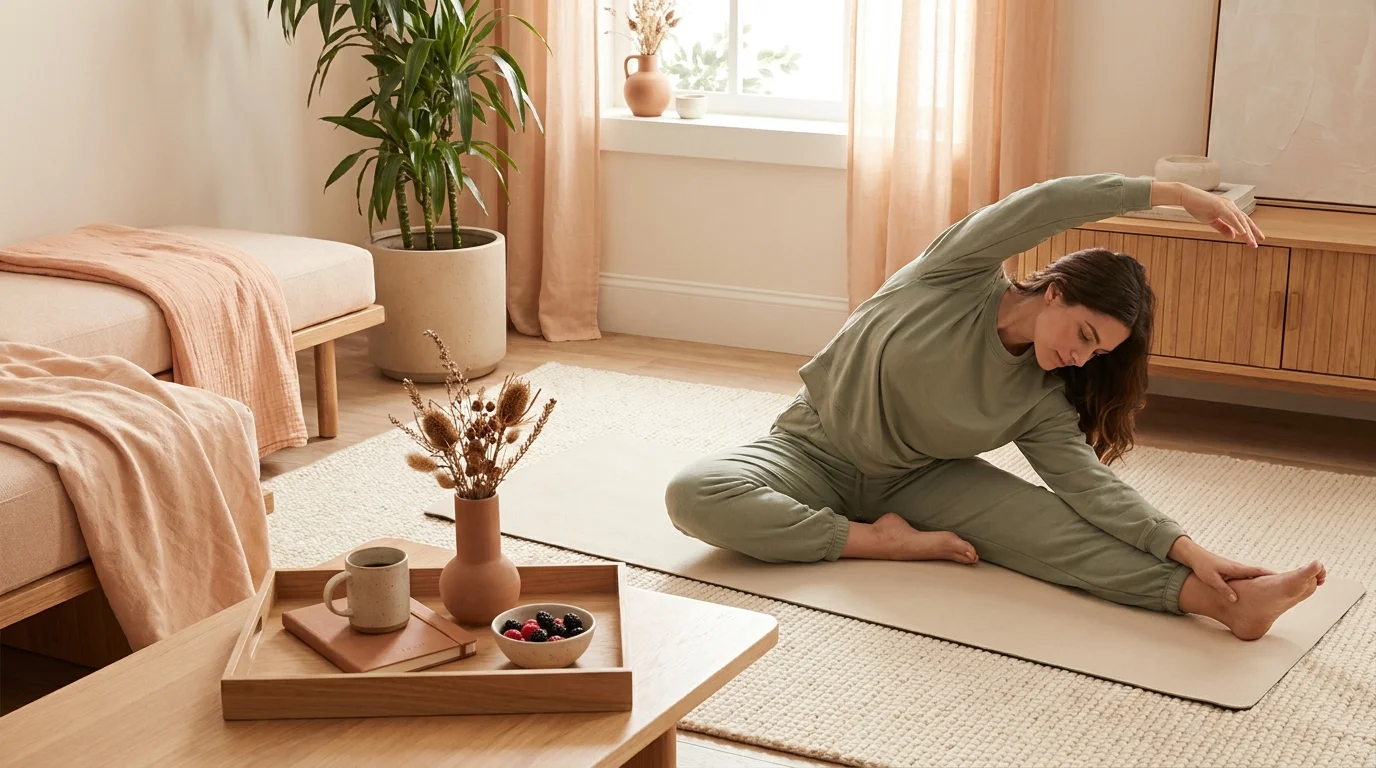
This is a good phase for moderate, consistent movement rather than maximum effort. Swimming, Pilates, walking, and yoga tend to feel supportive rather than depleting. Strength training can continue but many people find reducing volume slightly and prioritising recovery between sessions helps maintain progress without accumulating excessive fatigue.
Injury Risk: What the Research Actually Shows
ACL injury is the most studied cycle-related injury in sports medicine, but the same hormonal mechanisms affect other tissues too. Plantar fasciitis, patellar tendinopathy, and rotator cuff issues have all been observed to fluctuate in severity across the cycle, though this research is still emerging.
The key risk factors that cycle-aware training can address include:
- Peak estrogen laxity: Increase neuromuscular control work around ovulation, including single-leg squats, lateral stability drills, and landing technique practice.
- Luteal fatigue and form breakdown: Shorten sessions before they compromise form. Fatigue-related injury risk is real, and the luteal phase is when fatigue hits earlier and harder.
- Menstrual phase inflammation: Prioritise anti-inflammatory nutrition (omega-3s, leafy greens, turmeric) and allow genuine rest where possible rather than pushing through.
- Under-recovery across the whole cycle: Poor sleep, chronic stress, and inadequate protein all worsen connective tissue repair. These baseline factors matter more than any phase-specific protocol.
Muscle Recovery: Why Your Cycle Timing Matters
It is not just injury risk that shifts across your cycle. How quickly you recover from training also changes substantially. During the follicular phase, the anabolic environment created by rising estrogen means that muscles repair and adapt more efficiently. Soreness after hard sessions tends to resolve faster, and you can generally handle more training volume with less residual fatigue.
During the luteal phase, the opposite tends to be true. Progesterone has mild catabolic properties (it can increase protein breakdown), and the overall hormonal environment is less conducive to rapid muscle repair. This does not mean muscle building stops, but it does mean that recovery demands are higher, and that cramming in extra sessions during this phase often backfires.
Practical strategies to support muscle recovery across your cycle include:
- Protein timing: Aim for 25-40g of quality protein within two hours of training, and prioritise leucine-rich sources like eggs, meat, fish, or quality protein powders. This matters especially in the luteal phase.
- Sleep prioritisation: Growth hormone is released during deep sleep and is central to tissue repair. Poor sleep disrupts this, regardless of cycle phase.
- Magnesium: Supports muscle relaxation and reduces cramping. Many people are deficient, and this becomes more symptomatic premenstrually.
- Active recovery: Light movement such as walking, stretching, or swimming promotes circulation and reduces delayed-onset muscle soreness (DOMS) without adding significant training stress.
Practical Phase-by-Phase Movement Guide
Menstrual (Days 1-5 approximately)
Focus on gentle, restorative movement. Yin yoga, walking, and light swimming are ideal. If you feel good, moderate strength work is fine, but do not force high intensity. Prioritise warmth, anti-inflammatory nutrition, and sleep.
Follicular (Days 6-13 approximately)
Ramp up intensity and volume. This is your best window for learning new skills, increasing loads, and tackling challenging cardio. Neuromuscular warm-up becomes more important as estrogen rises toward ovulation.
Ovulatory (Days 14-16 approximately)
Leverage your peak power while being deliberate about joint stability. Add plyometric control drills, practice landing mechanics, and do not skip your warm-up. This is also a great time for team sport, competition, or high-skill activities.
Luteal (Days 17-28 approximately)
Moderate your effort and focus on consistency over intensity. Pilates, cycling, strength training at reduced volume, and yoga all work well. Listen to your body in the late luteal phase and allow extra recovery time if needed. Focus on protein intake and sleep quality.
Key Statistics and Sources
- Female athletes are 2-8x more likely to sustain ACL injuries than male athletes, with hormonal fluctuation cited as a contributing factor. NIH, 2012
- ACL laxity is significantly greater during the preovulatory phase, corresponding with peak estrogen. American Journal of Sports Medicine
- Collagen, tendon, and ligament tissues contain estrogen, progesterone, and relaxin receptors, confirming their hormone-responsive nature. NIH, 2019
- Muscle protein synthesis is enhanced during the follicular phase due to the anabolic effects of estrogen on skeletal muscle. PubMed
- Perceived exertion during the same absolute workload is measurably higher in the luteal phase due to elevated core temperature and altered fuel metabolism. NIH, 2018