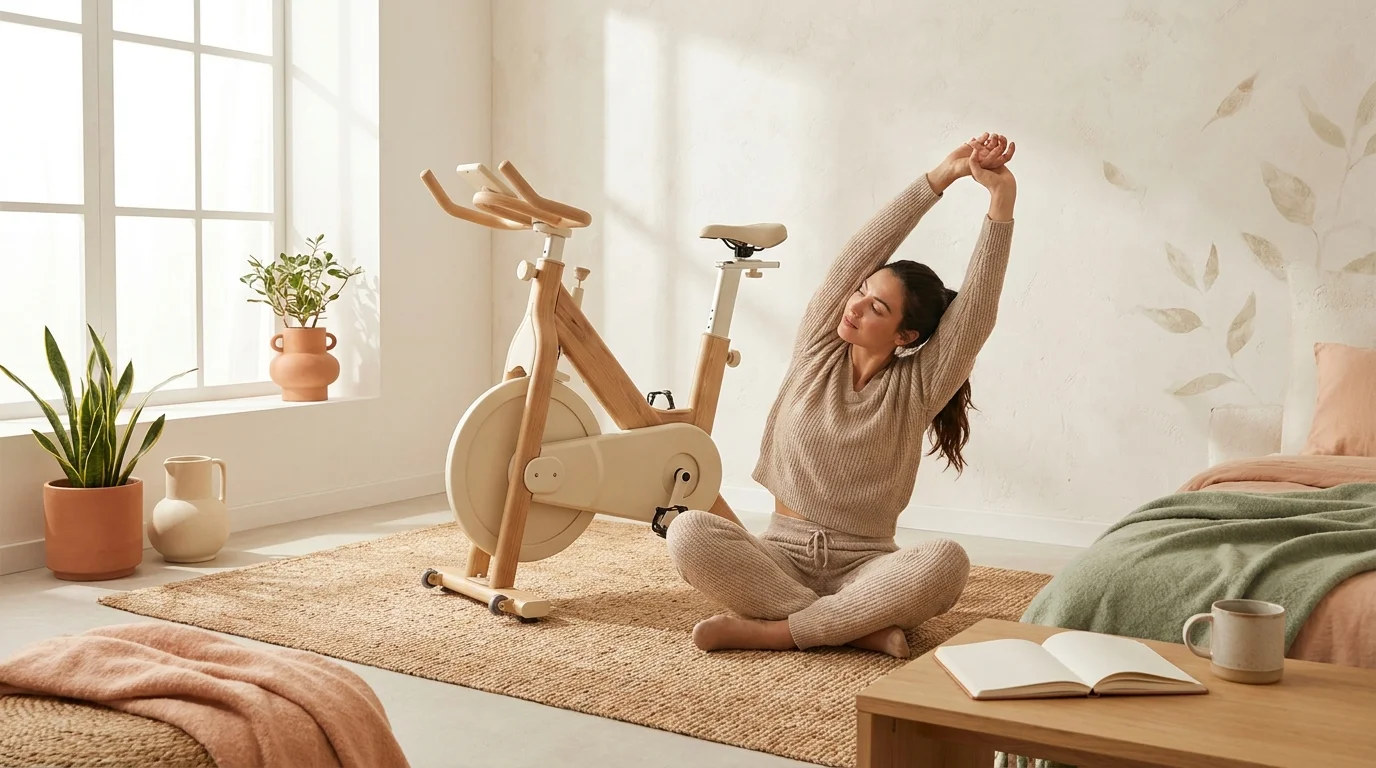
You clip into the pedals, the instructor cranks up the playlist, and you push hard for 45 minutes. Some days it feels electric. Other days your legs are lead, your motivation is nowhere, and you limp off the bike wondering what went wrong. The difference is rarely your fitness level or your mental grit. More often, it comes down to where you are in your menstrual cycle.
Indoor cycling, whether that is a studio spin class, a Peloton session, or a quiet ride on a stationary bike, is one of the most popular forms of cardio for women. It is low-impact on the joints, highly adjustable in intensity, and genuinely enjoyable when the conditions are right. But most training plans treat every week the same, ignoring the profound hormonal shifts that shape your energy, cardiovascular capacity, perceived effort, and recovery across a 28-to-35-day cycle.
This guide breaks down exactly how to ride with your hormones, not against them, so every session counts.
What happens to your body during indoor cycling?
Indoor cycling is primarily an aerobic cardiovascular workout that also recruits significant lower-body musculature, including the glutes, quads, hamstrings, and calves. At higher intensities it crosses into anaerobic threshold work, demanding greater glycogen use, respiratory effort, and post-exercise recovery time.
Because indoor cycling taxes multiple physiological systems simultaneously, it is especially sensitive to hormonal context. Your estrogen and progesterone levels influence cardiovascular efficiency, substrate use (whether you burn fat or carbohydrate for fuel), thermoregulation, perceived exertion, and muscle repair. Understanding these connections is the foundation of smarter riding.
How does estrogen affect your cycling performance?
Estrogen supports cardiovascular efficiency, increases aerobic enzyme activity, and improves the ability to use fat as a fuel source. Rising estrogen in the first half of the cycle means more oxygen delivery to working muscles, better heart rate variability, and a stronger response to high-intensity efforts.
Research published by the National Institutes of Health confirms that estrogen has direct effects on skeletal muscle adaptation and cardiovascular function, with higher estrogen associated with greater aerobic capacity and faster recovery between high-intensity bouts. This is the physiological reason many women feel notably stronger and more energised in the first two weeks of their cycle.
"Estrogen acts almost like a performance-enhancing context. When it is elevated, women tend to have faster VO2 responses, lower perceived effort at the same workload, and better neuromuscular coordination. Ignoring that window is leaving real performance gains on the table."
Dr. Stacy Sims, PhD, Exercise Physiologist and Researcher, Author of Roar, Stanford University
What is the best indoor cycling approach during your menstrual phase?
During menstruation, estrogen and progesterone are at their lowest. Energy may be reduced, particularly in the first one to two days, but many women feel a genuine lift by days three to four as estrogen begins to climb. Light to moderate rides are ideal early on, with the option to increase intensity as bleeding lightens.
If you have significant cramping or fatigue, a gentle 20-to-30-minute recovery ride at low resistance can actually ease discomfort by increasing pelvic blood flow and releasing endorphins, without demanding full glycogen reserves. Listen to your body here. Forcing a high-intensity interval session on day one often leads to greater inflammation and slower recovery.
Phase 1 Riding Strategy: Menstrual Phase (Days 1-5)
- Days 1-2: Gentle, low-resistance steady state. 20-30 minutes maximum.
- Days 3-5: Gradually increase duration and pace as energy returns.
- Prioritise warm-up and cool-down. Iron losses from bleeding increase fatigue risk.
- Hydration matters more here. Prostaglandins can increase fluid sensitivity.
How does the follicular phase change your riding capacity?
The follicular phase (roughly days 6-13) is when estrogen rises steadily toward its pre-ovulatory peak. This is the single best window in your cycle for high-intensity indoor cycling, interval training, and personal records. Your body is primed for performance.
Pain tolerance increases, perceived effort drops at the same output, and your cardiovascular system responds more efficiently to hard efforts. Spin interval sessions, hill climbs, and threshold rides all land better here. You can handle more volume and recover faster between efforts.
A study in the Journal of Physiology found that peak muscle strength and anaerobic power output were significantly higher in the follicular and ovulatory phases compared to the mid-luteal phase, supporting the case for scheduling your most demanding sessions in these early cycle weeks.
Phase 2 Riding Strategy: Follicular Phase (Days 6-13)
- This is your power window. Go for interval training, HIIT spin, and speed work.
- Increase session duration and resistance. Your recovery capacity is high.
- Try that challenging class you have been hesitant about.
- Fuel adequately. Carbohydrate tolerance is better here than in the luteal phase.
What happens to your cycling around ovulation?
Around ovulation (days 13-16), estrogen peaks and a testosterone surge occurs briefly. This creates a window of peak power, confidence, and motivation. It is an excellent time for max-effort rides, personal record attempts, or high-energy group classes that benefit from competitive energy.
One important caveat: the surge in estrogen and relaxin around ovulation increases ligament laxity slightly. For cycling this is less of a concern than in impact sports, but it is worth ensuring your bike fit is correct and that your cleats are well-aligned to avoid knee strain.
Phase 3 Riding Strategy: Ovulatory Phase (Days 13-16)
- Maximum effort sessions and group classes. Energy and motivation are peaking.
- Check cleat alignment and saddle height. Ligament sensitivity increases slightly.
- Use this window to build progressive overload for later cycle phases.
Why does indoor cycling feel harder in the luteal phase?
After ovulation, progesterone rises sharply alongside residual estrogen. Progesterone increases core body temperature by 0.3-0.5 degrees Celsius, raises resting heart rate, shifts fuel use toward glycogen over fat, and elevates the perception of effort at the same workload. Your body is not failing. It is working differently.
This is the reason a spin class that felt manageable last week suddenly feels suffocating in the week before your period. It is not a fitness regression. It is a hormonal reality that nearly every cycling programme ignores completely.
"Women in the mid-to-late luteal phase have a measurably higher ventilatory response and core temperature during the same cycling effort. If we do not adjust intensity or duration expectations, we are setting women up for perceived failure and unnecessary fatigue."
Dr. Georgie Bruinvels, PhD, Sport and Exercise Scientist, Orreco and University College London
Research published in Sports Medicine confirms that thermoregulatory demands are significantly higher during the luteal phase, particularly in warm environments, which has direct implications for indoor cycling in heated studios or poorly ventilated rooms.
How should you adjust your indoor cycling in the luteal phase?
The early luteal phase (days 17-21) still holds reasonable energy and strength. Focus on moderate intensity, tempo rides, or endurance-style steady-state cardio. As you move into the late luteal phase (days 22 to cycle end), reduce intensity, prioritise shorter sessions, and treat recovery as productive training.
Practical adjustments for luteal phase riding:
- Lower the resistance slightly and accept a higher perceived effort at the same or lower wattage. This is physiologically accurate, not weakness.
- Increase pre-ride hydration and add electrolytes. Progesterone has mild aldosterone-like effects that can shift fluid balance.
- Ride cooler if possible. Use a fan, choose air-conditioned studios, or ride in the cooler part of the day to offset elevated core temperature.
- Shorten your sessions in the final five to seven days before your period. A 30-minute moderate ride is more productive than a 50-minute effort that leaves you depleted.
- Increase carbohydrate intake before and after. Progesterone shifts fuel use toward glycogen, meaning you burn through carbohydrate stores faster. Under-fuelling in the luteal phase is a common and avoidable mistake.
Phase 4 Riding Strategy: Luteal Phase (Days 17-end)
- Early luteal (days 17-21): Moderate tempo rides, steady-state cardio, strength intervals.
- Late luteal (days 22+): Short, easy rides. Focus on movement, not performance metrics.
- Fan or cool studio essential. Core temperature is already elevated.
- Eat a carbohydrate-containing snack 30-45 minutes before riding.
- Do not judge your fitness by this phase. Trust the data from the follicular window.
Does heart rate response change across your cycle during cycling?
Yes, and understanding this can prevent both overtraining and unnecessary self-criticism. In the luteal phase, resting heart rate rises by an average of 2-5 beats per minute, and exercise heart rate at the same workload also increases. This means heart rate zones shift across the cycle and should be interpreted accordingly.
If you train by heart rate, using fixed zone targets throughout the month will lead to under-training in the follicular phase (when you can push harder at the same heart rate) and overtraining in the luteal phase (when hitting the same target zone requires more physiological cost). A smarter approach is to track heart rate variability daily and use perceived exertion as a secondary metric, especially in the late luteal phase.
What should you eat around indoor cycling sessions to support hormonal health?
Nutrition timing and composition for indoor cycling should shift with your cycle phases. In the follicular and ovulatory phases, your body handles carbohydrates efficiently and recovers well. In the luteal phase, increase total caloric intake slightly, prioritise protein for recovery, and eat a carbohydrate-rich snack before rides to prevent early glycogen depletion.
Key nutritional considerations for each phase:
- Menstrual phase: Iron-rich foods post-ride (lentils, dark leafy greens, red meat if you eat it) to replace losses. Anti-inflammatory foods like oily fish and berries support recovery.
- Follicular phase: Higher carbohydrate tolerance supports interval training. Lighter meals work well because digestion is efficient.
- Ovulatory phase: Similar to follicular. Ensure adequate hydration because this is a high-output window.
- Luteal phase: Increase protein to at least 1.6-2g per kg of bodyweight. Add a pre-ride snack with 20-30g of carbohydrate. Magnesium supplementation (especially magnesium glycinate) can reduce muscle cramps and improve sleep quality during this phase.
Key Statistics and Sources
- Core body temperature rises by 0.3-0.5 degrees Celsius in the luteal phase, increasing perceived effort at the same cycling intensity. Sports Medicine, 2020
- Estrogen enhances aerobic capacity and fat oxidation, with peak aerobic performance consistently measured in the follicular and ovulatory phases. NIH Review, 2012
- Resting heart rate increases by an average of 2-5 bpm in the luteal phase, meaning heart rate zone targets should be adjusted accordingly. Journal of Physiology, 2019
- Approximately 90% of women report physical or psychological premenstrual symptoms that affect exercise performance, yet most training programmes do not account for cycle phase variation. Office on Women's Health
- Glycogen utilisation is higher in the luteal phase compared to the follicular phase at the same cycling intensity, highlighting the need for increased carbohydrate intake before sessions. Journal of Physiology, 2019
How do you start applying this to your actual riding routine?
Start simple. Track your cycle dates alongside your session ratings using a perceived effort scale of 1-10. Within two to three cycles you will identify clear patterns: the days you feel like you could ride forever, and the days every gear feels impossible. Use that data to structure your schedule intentionally.
Practical first steps:
- Note your cycle phase before each ride and log perceived effort, heart rate, and mood afterward.
- Move your hardest planned sessions (intervals, climbs, competitive classes) to days 7-14.
- Book lighter, shorter sessions or rest days for the five to seven days before your period is due.
- Adjust pre-ride nutrition based on phase: lean and efficient in the follicular, fuelled and carbohydrate-forward in the luteal.
- Use a fan or cooler environment in the luteal phase and never compare luteal-phase performance to follicular-phase numbers.
Indoor cycling is a genuinely brilliant training modality. It is adaptable, scalable, and accessible. But like any tool, it works best when used intelligently. Your cycle gives you a built-in periodisation framework that most training plans overlook entirely. Start using it, and the bike becomes a very different experience.