Matcha has earned a permanent spot on the wellness menu, and for good reason. It delivers a calm, steady energy without the jittery spike and crash that coffee often brings. But if you drink matcha the same way every day of your cycle, you may be missing something important: your hormones change dramatically across four distinct phases, and those shifts affect how your body processes caffeine, responds to L-theanine, and handles the polyphenols in green tea. Timing your matcha to match your cycle is a small tweak with a surprisingly large payoff.
What makes matcha different from other caffeinated drinks?
Matcha contains caffeine, L-theanine, EGCG (epigallocatechin gallate), and chlorophyll, all in a concentrated powdered form. The combination of caffeine with L-theanine produces a calmer, more sustained alertness than coffee, often described as focused without being wired, making it a gentler option for hormone-sensitive individuals.
Unlike coffee, where caffeine absorption is rapid and peaks sharply, L-theanine in matcha slows the release of caffeine into the bloodstream. Research published by the National Institutes of Health (2021) confirmed that the L-theanine and caffeine combination in green tea improves sustained attention and reduces mental fatigue more effectively than either compound alone. That sustained, lower-cortisol-spike response matters a great deal depending on where you are in your cycle.
EGCG, the primary catechin in matcha, also has mild phytoestrogenic activity, meaning it can interact with estrogen receptors. This is relevant across phases where estrogen is rising, peaking, or declining.
How does your cycle affect caffeine sensitivity?
Your sensitivity to caffeine is not fixed. It fluctuates with estrogen and progesterone levels throughout your cycle. High-estrogen phases tend to extend caffeine clearance time, while the luteal phase increases vulnerability to anxiety and sleep disruption from the same dose that felt fine mid-cycle.
Estrogen slows the liver enzyme CYP1A2, which is responsible for breaking down caffeine. During the late follicular and ovulatory phases, when estrogen peaks, caffeine stays in your bloodstream longer. For some women this feels great because a smaller amount of matcha goes further. For others, especially those prone to estrogen-related symptoms, it can tip into overstimulation.
Progesterone, dominant in the luteal phase, competes with GABA receptors and interacts with the central nervous system in ways that amplify anxiety responses to stimulants. This is part of why that afternoon matcha that felt fine in week two of your cycle can feel uncomfortably activating in week three or four.
"Caffeine metabolism is genuinely hormone-dependent. Women in the luteal phase can experience measurably higher cortisol responses to the same caffeine dose that had no effect mid-cycle. This is not sensitivity or weakness; it is biochemistry."
Dr. Satchidananda Panda, PhD, Professor of Regulatory Biology, Salk Institute for Biological Studies
What happens during the menstrual phase?
During menstruation, both estrogen and progesterone are at their lowest. Energy is naturally reduced, inflammation peaks briefly, and the body benefits from warmth and nourishment rather than stimulation. Matcha can still be enjoyed, but lower doses and warmer preparations with anti-inflammatory additions tend to serve this phase best.
Prostaglandins drive cramping during menstruation, and high caffeine intake has been linked to increased prostaglandin sensitivity in some research. A small, warm cup of ceremonial-grade matcha, rather than a high-caffeine double-scoop preparation, is a pragmatic middle ground. Pairing matcha with warming spices like ginger or cinnamon during this phase supports circulation and can help ease cramp intensity.
Iron absorption is also a consideration during menstruation. The tannins and catechins in matcha can inhibit non-heme iron absorption when consumed close to an iron-rich meal. If you are managing heavy periods or low ferritin levels, wait at least 60 minutes after eating iron-rich foods before drinking matcha during your period.
Phase tip: menstrual
How does the follicular phase change your matcha response?
As estrogen begins rising in the follicular phase, energy, mood, and cognitive sharpness naturally improve. This is the phase where matcha tends to feel most enjoyable and effective, amplifying already-rising motivation and focus without pushing the system into overstimulation.
The follicular phase is broadly the most forgiving window for caffeine. Estrogen supports dopamine sensitivity, which means the mild dopaminergic boost from caffeine is felt more pleasantly here. EGCG also exerts antioxidant effects that support the developing follicle environment. Research from Harvard T.H. Chan School of Public Health highlights that the catechins in green tea support metabolic health and cardiovascular function, effects that complement the regenerative quality of the follicular phase.
This is also a good phase to experiment with matcha in its more concentrated forms, such as a thicker, traditional usucha preparation or a higher-quality ceremonial grade, because your system is robust and tolerant.
Phase tip: follicular
Is matcha a good choice around ovulation?
Ovulation marks peak estrogen and a brief LH surge. Energy and sociability are high. Matcha is well tolerated here, and the L-theanine component can be particularly useful for softening any pre-ovulatory anxiety that accompanies the hormonal surge, without dulling the natural sharpness of this phase.
Some women notice a mild anxious or wired quality in the day or two before ovulation as LH spikes and estrogen peaks simultaneously. In this window, the calming L-theanine in matcha can provide a subtle buffer. Choosing a slightly lower caffeine preparation, such as a thin usucha or a cold brew matcha made with a shorter steep, can preserve the L-theanine benefits while keeping caffeine exposure moderate.
The antioxidant activity of EGCG may also support egg quality during the ovulatory window. While most direct evidence comes from animal studies, the broader antioxidant benefit is well-supported in human research. A 2020 study in the Journal of Nutritional Biochemistry (NIH) found EGCG reduced oxidative stress markers in reproductive tissues.
Phase tip: ovulatory
Why is the luteal phase the trickiest time for matcha?
The luteal phase, especially the second half, is the most hormonally complex window for caffeine consumption. Rising progesterone, declining estrogen toward the end of the phase, and increased cortisol reactivity all converge to make even moderate matcha intake potentially disruptive to sleep, mood, and PMS symptoms.
This is the phase where many women report that their usual matcha habit suddenly feels "too much." The reasons are layered. Progesterone metabolises into allopregnanolone, a neurosteroid that interacts with GABA receptors and affects how the central nervous system responds to stimulants. Caffeine, as an adenosine antagonist, is more activating relative to baseline in a system that is already sensitised.
"Women often blame themselves for feeling anxious or sleep-disrupted in the week before their period without realising their caffeine tolerance has genuinely shifted. Reducing intake in the late luteal phase is a physiologically sound strategy, not a restriction."
Dr. Lara Briden, ND, Naturopathic Doctor and Author, Lara Briden Hormone Repair Manual
High caffeine intake in the luteal phase has also been associated with increased breast tenderness in some studies, likely because of the fluid-retaining and prostaglandin-related effects that caffeine can amplify. Reducing matcha to a single small morning serving and cutting off caffeine by midday during the late luteal phase gives the nervous system space to prepare for rest.
The good news: matcha at low to moderate doses still provides meaningful L-theanine, and L-theanine alone has demonstrated anxiolytic effects in research, meaning you can use a very lightly whisked matcha almost like a calming adaptogenic drink rather than a stimulant in this phase.
Phase tip: luteal
How does matcha quality affect hormone response?
Ceremonial-grade matcha contains the highest concentrations of L-theanine relative to caffeine, making it a better choice for hormone-sensitive phases. Culinary-grade matcha has higher caffeine and lower L-theanine proportions, which shifts the balance toward stimulation rather than calm focus.
Shade-grown matcha, the basis for ceremonial grades, accumulates more L-theanine because the plant produces it to compensate for reduced photosynthesis. A high-quality ceremonial matcha typically provides around 35 mg of caffeine and 25 mg of L-theanine per gram, while culinary grades may provide higher caffeine with proportionally less L-theanine. For cycle-aware use, investing in ceremonial grade is a practical decision, not a luxury one.
Lead contamination is also a genuine consideration. Because matcha involves consuming the whole leaf in powdered form rather than steeping and discarding, heavy metal accumulation matters more than with brewed green tea. Choose organic, Japan-sourced matcha from brands that publish third-party lab results for heavy metals.
What are the best ways to prepare matcha for each phase?
The preparation method affects the caffeine-to-L-theanine ratio, temperature, and how quickly the compounds enter your bloodstream. Warm, traditional preparations preserve more L-theanine activity, while cold preparations slow absorption and can feel gentler during sensitive phases.
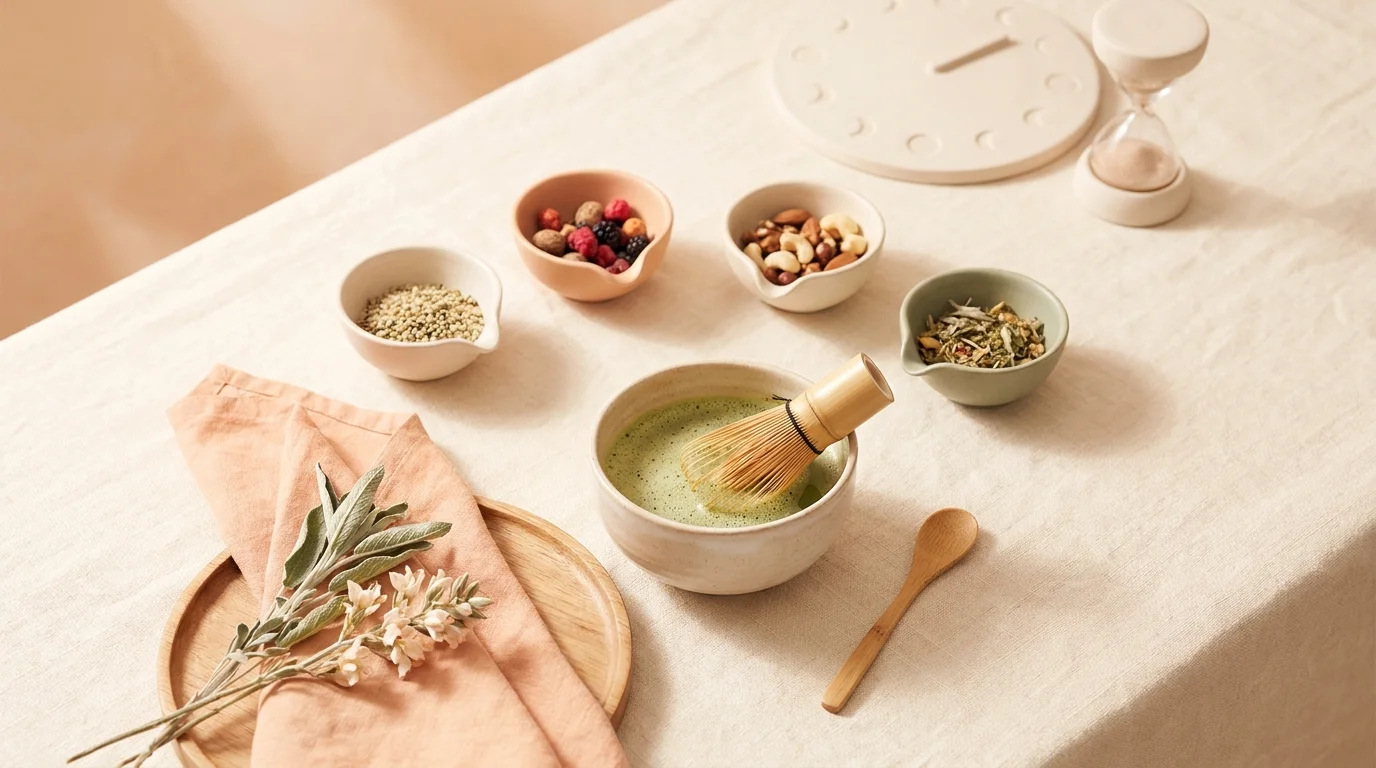
For the follicular and ovulatory phases, traditional hot whisked matcha or a warm matcha latte made with oat or almond milk works beautifully. For the luteal phase, a lightly whisked warm matcha made with a smaller amount of powder (half a teaspoon instead of a full teaspoon) keeps caffeine low while still delivering L-theanine. For the menstrual phase, a matcha golden milk blend, combining a quarter teaspoon of matcha with turmeric, ginger, and a pinch of black pepper in warm oat milk, layers anti-inflammatory ingredients with the gentle energy of low-dose matcha.
Key statistics and sources
- L-theanine combined with caffeine improved sustained attention and reduced mental fatigue in a randomised controlled trial. NIH, 2021
- EGCG reduced oxidative stress markers in reproductive tissues in a controlled study. Journal of Nutritional Biochemistry via NIH, 2020
- Caffeine metabolism is regulated by the CYP1A2 enzyme, which is modulated by estrogen levels across the cycle. NIH Bookshelf, Pharmacogenomics
- Green tea catechins are associated with improvements in metabolic health markers in women, according to Harvard nutrition research. Harvard T.H. Chan School of Public Health
- One gram of ceremonial matcha provides approximately 35 mg caffeine and 25 mg L-theanine, with a ratio that favours calm focus over stimulation. (NIH 2021)
- Tannins and catechins in green tea can reduce non-heme iron absorption by up to 70 percent when consumed simultaneously with iron-rich meals. NIH, 2014