If you have been searching for the best PCOS diet plan for Indian women, you have probably noticed that most advice online defaults to Western food lists: kale salads, avocado toast, and almond butter smoothies. Helpful, perhaps, but not exactly what is sitting in your kitchen. The good news is that a traditional Indian diet is actually extraordinarily well-suited to managing PCOS, once you know which principles to apply and which habits to tweak. For the broader hormonal picture, start with The Complete Guide to PCOS and then come back here for the food specifics.
PCOS affects roughly one in five South Asian women, a rate that is notably higher than the global average, and insulin resistance is a central driver in the majority of cases. That means the way you eat, specifically how your meals affect blood glucose, is one of the most powerful levers you have. The spices in your masala dabba, the lentils in your dal, the seeds in your tempering: these are not obstacles to work around. They are medicine, if you use them strategically.
What Makes an Indian PCOS Meal Plan Different?
An Indian PCOS meal plan differs from generic PCOS advice because it must account for a cuisine that is naturally rich in legumes, spices, and vegetables but also traditionally high in refined carbohydrates like white rice, maida, and sugary mithai. The goal is to keep what works, modify what does not, and never feel like you are eating a "diet."
South Asian diets tend to be carbohydrate-heavy, which is not inherently bad, but the type and timing of those carbohydrates matter enormously for PCOS. A breakfast of poha, upma, or paratha eaten without adequate protein can spike blood sugar quickly, triggering the insulin surge that drives androgen production. The fix is rarely to eliminate these foods. It is to pair them smarter: add a protein source, include fat, and sequence your meal so vegetables come first.
Why Does Insulin Resistance Hit South Asian Women Harder?
South Asian women are genetically predisposed to higher visceral fat accumulation and greater insulin resistance at lower BMIs than Western populations. This means a woman of Indian heritage with a "normal" body weight can still have significant metabolic PCOS, making dietary precision especially important in a south asian pcos diet approach.
Research published by the American Diabetes Association confirms that South Asians develop insulin resistance and type 2 diabetes at younger ages and lower body weights than European populations, a phenomenon linked to differences in body fat distribution and adipokine signalling. The ADA's classification and diagnosis guidelines acknowledge ethnicity-specific risk thresholds for this reason.
For women with PCOS, this matters because high insulin directly tells the ovaries to produce more testosterone, which worsens symptoms like irregular cycles, facial hair, and acne. Stabilising blood sugar is not just a weight strategy: it is a hormone strategy.
"Insulin resistance is present in approximately 70% of women with PCOS regardless of weight. For South Asian women specifically, we often see metabolic dysfunction appearing at lower BMI thresholds, which means we cannot rely on weight alone as a screening tool."
Dr. Anuja Dokras, MD PhD, Director, Penn PCOS Center, University of Pennsylvania
What Should the Best PCOS Diet Plan for Indian Women Include?
The best PCOS diet plan for Indian women should prioritise low-glycaemic whole grains, protein at every meal, fibre-rich legumes, anti-inflammatory spices, and healthy fats. It should minimise refined flour, added sugar, and ultra-processed snacks while keeping the flavours, rhythms, and social joy of Indian eating fully intact.
Carbohydrates: Swap, Do Not Stop
The most effective shift in a PCOS diet India context is not removing carbohydrates but choosing ones that release glucose more slowly. Millet varieties like jowar, bajra, and ragi have lower glycaemic indices than white rice or maida and have been eaten across the subcontinent for centuries. Brown rice is a helpful upgrade, and if white rice is non-negotiable for you culturally or emotionally, eating it with dal, sabzi, and curd before the rice itself slows the glucose response significantly.
A 2018 study in Nutrients found that food sequencing, eating vegetables and protein before carbohydrates, reduced postprandial glucose spikes by up to 37% in insulin-resistant individuals. This single strategy costs nothing and changes nothing about what you eat.
Protein: The Missing Anchor
Many Indian diets, especially vegetarian ones, underdeliver on protein at breakfast. Moong dal chilla, besan (chickpea flour) preparations, paneer bhurji, eggs, or Greek-style curd with seeds can anchor your first meal of the day and dramatically reduce mid-morning cravings. Aim for 25-30 grams of protein at breakfast as a starting target.
Legumes, a cornerstone of Indian cooking, are genuinely excellent for PCOS: they provide protein, fibre, and resistant starch that feeds beneficial gut bacteria. If you want to understand how gut health intersects with PCOS symptoms, our article on PCOS and Gut Health goes into detail on the mechanisms.
The Spice Advantage
This is where a PCOS diet India approach has a genuine edge over most Western dietary frameworks. Several spices used daily in Indian cooking have clinically meaningful effects on insulin sensitivity and inflammation:
- Turmeric (haldi): Curcumin has demonstrated anti-inflammatory and insulin-sensitising effects in multiple studies.
- Cinnamon (dalchini): A meta-analysis found cinnamon supplementation significantly reduced fasting blood glucose and HOMA-IR in women with PCOS.
- Fenugreek (methi): Rich in soluble fibre and compounds that slow carbohydrate digestion; methi seeds soaked overnight and consumed in the morning is a traditional remedy with real evidence behind it.
- Cumin (jeera): Supports digestive enzyme activity and has shown modest blood sugar lowering effects.
Use these freely and generously. They are not supplements you need to buy: they are already in your kitchen.
How Does an Indian PCOS Meal Plan Look Day to Day?
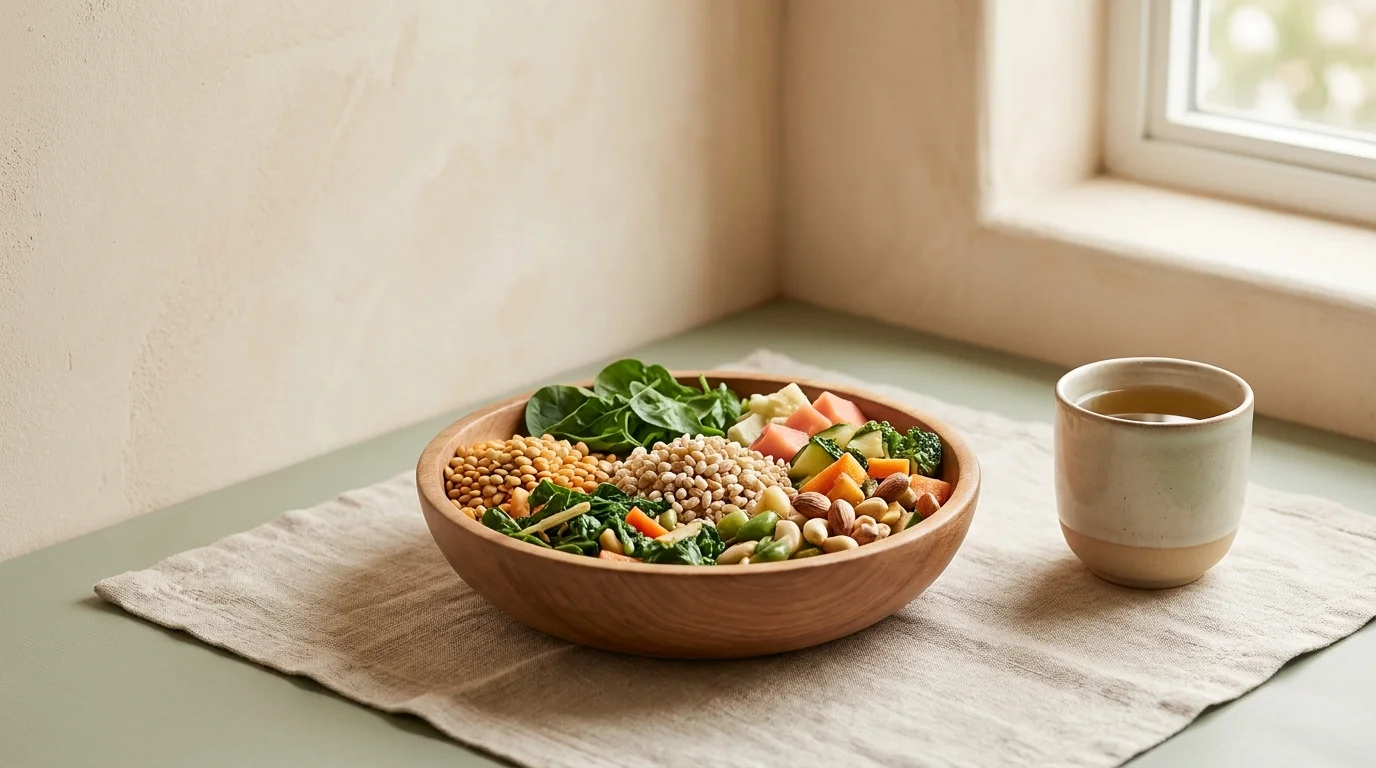
A practical Indian PCOS meal plan structures three balanced meals and one or two protein-anchored snacks around low-glycaemic grains, legumes at least twice daily, vegetables at every meal, healthy fats from ghee, nuts, and seeds, and anti-inflammatory spices throughout. Dairy is tolerated by many women with PCOS but can worsen acne in some: monitor your own response.
Sample Day on a PCOS Diet India Plan
Morning (before eating): One glass of warm water with a pinch of cinnamon and half a teaspoon of soaked methi seeds.
Breakfast: Moong dal chilla (2-3 small) with a side of coriander chutney and one small bowl of curd. Or: 2-egg bhurji with vegetables cooked in half a teaspoon of ghee, served with one slice of multigrain toast.
Mid-morning snack (optional): A small handful of walnuts or almonds, or roasted chana with a pinch of chaat masala.
Lunch: One or two small rotis made with jowar or a jowar-atta blend, one bowl of dal, one seasonal sabzi with lots of vegetables, one small bowl of curd or raita. Eat vegetables and dal first, roti last.
Evening snack: Roasted makhana (fox nuts) with turmeric and pepper, or a small bowl of boiled chana chaat with tomato, onion, and lemon. Pair with green tea or turmeric latte.
Dinner: A lighter meal than lunch. Khichdi made with moong dal and lots of vegetables is ideal: easy to digest, low glycaemic, and genuinely satisfying. Or a bowl of palak paneer with one small millet roti.
"Women with PCOS do not need a restrictive diet. They need a consistent, anti-inflammatory eating pattern that keeps blood sugar stable across the day. For Indian women, that means leveraging their existing food culture rather than abandoning it."
Dr. Nisha Gopalan, RD, Registered Dietitian specialising in South Asian metabolic health, Johns Hopkins Medicine
Which Foods Should a South Asian PCOS Diet Limit?
A south asian pcos diet should limit white maida products like naan, white bread, biscuits, and packaged snacks; sugary drinks including packaged fruit juice and sweetened lassi; deep-fried items eaten frequently; and ultra-processed convenience foods. These spike insulin rapidly, worsen androgen levels, and drive the inflammation cycle that underlies PCOS symptoms.
This does not mean never. It means not daily and not in large quantities. A piece of mithai at a festival is not the problem. A biscuit with every chai, three times a day, every day, is where the cumulative insulin load builds up.
Dairy is worth mentioning separately. Some research, including a 2019 review in Nutrients on dairy and acne, suggests that high dairy intake (particularly low-fat dairy and whey) may worsen androgen-driven skin symptoms in some women. Full-fat curd and ghee in moderate amounts appear to be better tolerated. If you have significant PCOS acne on the jawline, it is worth experimenting with reducing milk while maintaining curd and ghee, and tracking your skin response over 6-8 weeks.
Blood sugar management also connects closely to how well you ovulate. If irregular cycles are your primary concern, our article on how to ovulate regularly with PCOS pairs well with this dietary framework.
What About Supplements for PCOS on an Indian Diet?
Food first is always the priority, but a few supplements have particularly strong evidence for PCOS in the context of an Indian diet pattern. Vitamin D deficiency is extremely common in South Asian women due to melanin levels, indoor lifestyles, and dietary patterns, and low vitamin D directly worsens insulin resistance and PCOS symptoms. Getting levels tested and supplementing if deficient is one of the highest-value interventions available.
Inositol (specifically the myo-inositol and D-chiro-inositol combination) has robust evidence for improving insulin sensitivity, menstrual regularity, and egg quality in PCOS. Omega-3 fatty acids help reduce the chronic low-grade inflammation common in PCOS. And magnesium, often low in women with insulin resistance, supports both blood sugar regulation and sleep quality.
Key Takeaways: PCOS Diet for Indian Women
- Eat protein at every meal, especially breakfast (aim for 25-30g)
- Sequence meals: vegetables and protein before grains
- Choose millets and whole grains over maida and white rice
- Use turmeric, cinnamon, fenugreek, and cumin daily and generously
- Eat legumes at least twice a day: dal, chana, rajma, moong
- Limit packaged snacks, sugary drinks, and frequent fried foods
- Check vitamin D levels and supplement if deficient
- Monitor dairy response if acne or inflammation is prominent
Key Statistics and Sources
- PCOS affects approximately 20% of South Asian women, compared to a global average of 8-13%. WHO PCOS Fact Sheet
- Insulin resistance is present in up to 70% of women with PCOS regardless of BMI. Nutrients, 2018
- Food sequencing (vegetables before carbohydrates) reduces postprandial glucose spikes by up to 37%. Nutrients, 2018
- Cinnamon supplementation significantly reduced fasting glucose and HOMA-IR in women with PCOS in a 2020 meta-analysis. PubMed, 2020
- South Asian individuals develop type 2 diabetes at BMIs 3-5 kg/m2 lower than European populations. ADA Standards of Care, 2022
- Vitamin D deficiency is present in over 60% of South Asian women and directly worsens insulin resistance in PCOS. PubMed, 2014